Rows of garlic, their protective, winter blanket of straw removed, will easily survive cool spring days
With the growing popularity of home gardening there must be a lot of people on a steep learning curve trying to come to grips with the apparent uncertainty of the weather.
After all, spring seemed to have arrived early in the Canada-U.S., Great Lakes area with temperatures in the first week of April that were seemingly warm enough to allow for the planting of early hardy, veggie crops like peas, beets, carrots, onion sets, and potatoes.
After years of gardening that should have made me know better, I again found it hard to resist the temptation of eagerness to get started. But I compromised, planting only a couple of rows of early edible pod peas; after all they are called ‘snow peas’ for a reason, I pseudo-rationalized. I also planted a row of onion sets, and two rows of Chieftain red potatoes. The date was April 6. I’ve never planted potatoes that early. Meanwhile, I held off on planting beets, swiss chard, carrots and radishes.
I should have held off entirely, especially the peas. That’s also considering I plant untreated seed; that is, seed not coated with fungicide to keep it from rotting in the ground if the soil temperature is not warm enough for germination. A few more days of warm weather, and the pea seeds and I might have got away with it. There was evidence of germination just getting started. But now, April 18, there’s no sign of little, green pea-plants emerging. I few might survive, but the rows will likely have to be replanted. With temperatures now forecast over the next few days to be below freezing at night here on Ontario’s Bruce Peninsula, the two rows of seed potatoes buried several inches in their rows should be okay; but just to be sure I’ve covered them with a generous layer of straw. The same goes for the onion sets.
Two rows of seed potatoes planted, covered with straw to help insulate them from the cold. After it warms up the straw can be raked aside and mulched around the plants to prevent potato beetles.
Meanwhile, in the back garden, the numerous fall-planted rows of garlic are looking good. They will be okay without the straw blanket I covered them with for the winter and raked away a couple of weeks ago to give them sun. Garlic, fast becoming a popular crop in southern Ontario, is hardy enough.
I’m not a newcomer on this planet, having lived my ‘three-score years and ten’ and more, but in memory it seems to me the advent of spring, once arrived, was much more reliable than now.
It’s well known that the location of the jet streams, the high altitude winds that circle the globe in temperature regions, is a major determining factor in weather. In the northern hemisphere, the generally west-blowing jet stream keeps colder temperatures north of us, and warmer, south. As the seasons change with the sun, the jet stream used to move south and north in a fairly stable way. But recent years have seen a growing school of thought that climate change is weakening the jet stream, as the Arctic warms relatively faster than tropical regions. As a result, The jet stream’s pattern has become more erratic with deep dips to the south that sometimes appear to get stuck, or ‘blocked’ over certain areas. I keep a close watch on jet stream maps, and have observed, anecdotally, that often in recent years it has dipped down in large tongues or nodes and lingered for long periods of time south of the Great Lakes. Sometimes, it appears to even fragment and get scattered. Depending on the seasons, all that has resulted in long periods of extreme cold weather in winter, and prolonged cool weather in spring. The spring of 2020 at this time, was similar to what’s happening now: an unusual warm spell in early spring, followed by much colder weather, and then a serious snow event in April. I note snow is in the forecast for this week.
Now, snow in April is not unusual. I well remember driving to work one morning years ago in June with snow coming down. But it’s the sudden, dramatic changes and extremes that now seem new and unusual.
The experts admit evidence of the impact climate change is having on the Jet Stream, and therefore weather, is still inconclusive. They do, after all, have a duty to be precise in reaching their conclusions. Meanwhile, the skeptics can find all kinds of supposed reasons why it’s not happening. I choose to believe climate change is having a destabilizing effect on the jet stream that needs to be taken seriously.
From the point of view of gardening, and farming, I would say you are best advised to keep in mind there is a new norm happening: the weather is becoming more erratic. If it seems too good to be true that warm spring weather has come too early, it more than likely has. And you should take a wait-and-see attitude to planting until the weather warms up to stay. Late April, early May is still a good time to plant cool-weather crops. They won’t do much growing until then anyway.
Above all, keep your eye on the jet stream: where it is, and where it’s expected to go. I recommend a new, interactive ‘global’ jet stream map put online by U.K.-based netweather.tv.
My recent discovery of the creative, literary works of late 19th Century, American author Kate Chopin, most notably her novel, The Awakening, has been a deeply moving and continuously thought-provoking experience. That meets one of the important criteria for a true work of art; and so does speaking so well to readers about what they may be experiencing, as they struggle to find themselves.
It wasn’t only for my own sake, but more especially for my maternal grandmother, Clara, whose tragic life I was reminded of as I read The Awakening and continue to think about it every day. Kate Chopin would have understood perfectly what happened to my grandmother; and would have felt for her. Maybe she is, right now, somewhere, somehow. It may sound strange, but I find consolation for my grandmother’s sake in such thoughts, thanks to Chopin
As a young woman of 28, and mother of two children she dearly loved, my grandmother was desperately unhappy and neglected in her marriage when she dared to fall in love with a married man, famous at the time, 100 years ago. But despite loving her too, he could not face the prospect of living openly in their love, and the consequences it was certain to have for him in the emotionally repressive, post-puritanical, societal norms of the time. That was especially true in the narrow-minded, provincial confines of WASPish (White, Anglo-Saxon, Protestant), Toronto “the Good” where she lived, or tried to. And it was also true of the U.S. Midwest where he was a church pastor, and a prominent figure in the progressive, social gospel movement.
As it was, the consequences of being a married woman who fell in love with a married man were terrible: a broken heart, the court-ordered loss of her first two children, her desperate abandonment of her love child, my mother, her lonely misery and abject poverty in Montreal for 18 years, and her death from cancer at an early age after her sudden return, alone, to her parental home in Toronto in 1942..
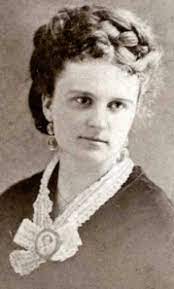
Kate Chopin
In The Awakening, Chopin’s heroine, Edna Pontellier, raised ‘American’ in Kentucky, is married to Leonce Pontellier, a wealthy member of upper-class, Creole society in Louisiana. She and her husband live in New Orleans, the focal point of the unique, French-based Acadian culture. He’s often away to the north, including New York City and Wall Street, as the story unfolds. Though apparently doting, he cares most about the material trappings of wealth, including what today would be called his ‘trophy wife.’ But she dares to question and ultimately rebel against all that. They have two young children; but Edna rejects the prevailing, social attitude that a woman should always sacrifice her needs for the sake of her children; ‘unessential things,’ yes, but not the soul of her being, as she struggles to discover what that is. She falls in love with a young man who, among other things, teachers her how to swim. That is a crucial, beginning point in her journey of self-discovery, including the awakening of her repressed sensuality. It continues through to the end of the unconsummated relationship with her ‘lover’ who abandons her, “because I love you,” he says in a parting note. Soon after that comes the final and still controversial ending of the novel when Edna, naked and alone on a beach, walks into the waters of the Gulf of Mexico. “He did not know; he did not understand. He would never understand,” she thinks, as she swims out as far as she can before exhaustion sets in. She had by then already rejected the possibility of other, passing lovers. She thinks fondly of her two young boys, left, apparently happy, in the care of their paternal grandmother in the countryside. But she affirms again her unwillingness to sacrifice herself and live for their sake only.
I confess to being troubled by how Chopin handles that important issue in The Awakening. It needs more attention. A key character in the novel, a happily married woman, tells Edna more than once to not give her children short shrift: “The children, the children!” she says. How Chopin’s heroine may have struggled with that begs for more creative exploration, especially when her two young sons are ultimately described in her apparently final thoughts as ‘antagonists’ seeking to control her life. It’s not hard to imagine how outrageous that must have seemed to many readers at the time, in a society where the role of woman was so locked-in to motherhood.
Speaking personally, being similarly ‘farmed out’ twice by a loving, well-intentioned, single mother to pseudo-foster parents – exploitive and abusive in one case – was a deeply troubling experience. I still struggle with it. There are other cultures in the world that have a more natural, realistic approach to parenting than one that puts all the pressure and responsibility on individual mothers: such things as a greater, shared reliance on both parents, the extended family, and the social group. There are many examples, even in the animal world.
A shallow, perhaps too-obvious interpretation of the ending of The Awakening assumes Edna’s suicide. The last the reader sees of her she has gone as far as she can out into the waters of the Gulf, with no strength left to make it back to shore. But Chopin, deliberately, I think, leaves her fate uncertain. Meanwhile, recollections of childhood memories, including walking through a “blue-grass meadow” with “no beginning and no end” come to Edna’s mind.
I am left with this thought: that Edna’s journey, her ‘Awakening,’ reaches its consummating climax, its ultimate expression of her sensuality-come-alive, in and with the sea. I might have said best would have been to go on living, in some state of love, in the world. But, in all the circumstances, Edna had realized that was not possible, that it could only lead to personal tragedy. Meanwhile, her spiritual and sensual reunion with the sea, is love, timeless and complete.
It’s also a testament to Chopin’s literary genius: to have written such a powerful scene in such a book on such a theme, in 1899, in the U.S. Midwest.
And yet, what an injustice, that The Awakening was widely condemned after its publication. Chopin was shunned in the St. Louis, Missouri community where she lived at the time. She had been born there, but married a Creole man herself, moved to Louisiana, and had six children. She, with her children, moved back to St. Louis after her husband died to look after her sick mother. She began writing in the 1890s as a way of overcoming depression after her mother died. She soon made a name for herself as a regional (Acadian) writer. But after the bad reaction to The Awakening, her further works were largely rejected. She died five years later and was virtually forgotten for 70 years. Now she is a regarded as a forerunner of the modern feminist movement. The Awakening and her short stories are required reading in literary studies.
But with all due respect to feminism, and her courageous contribution to it, any label, be it ‘regional writer’ or ‘feminist,’ diminishes her even now: Kate Chopin speaks of the human spirit in all its wonderful, though often tragic, complexity. There was much more she could have said, in the years before and after The Awakening, had she found her wings sooner. It is not quite a great novel, by a writer who clearly had it in her to be great.
My granddaughter Asia at the lookout. May you see your way clear, my dear.





 Finding Hope Ness