On being reminded of human goodness: a wonderful moment

The historic Great Hall of Toronto’s Union Station

“Keep your heart and mind open to the possibility of wonder: you never know what the next moment will bring.”

Recently, I have found myself saying that often, especially when someone I know, or have just met, talks about a personal struggle they’re experiencing to the point of despair, or how much they’re troubled about the terrible state of the world.

The wonder that might be seen, heard, or thought in the next moment may not save the world. It may be a relatively small thing in the broader personal or global context; but if it lifts your spirits to suddenly see the rising sun shining bravely through a small break in dark clouds, that is also wonderful. Let it lift and embrace you, and give you hope. “Anything is possible,” I often end up saying.

I took that attitude to heart myself just over a week ago when I ran into trouble trying to get to Kingston via Toronto to visit my daughter at her horse farm in rural, eastern Ontario.

I had it all worked out. At least I thought so; except what’s the point of having a plan if you don’t write it down and pay attention to it?

So, instead arriving at Guelph Central Station in time to catch a 12:55 pm GO bus to Union Station in Toronto, that bus had already left. I assured my good friend and son-in-law Ryan not to worry, and to head back north. I still had four hours to get to Union Station, even if I had to take another GO bus to Square One, in Mississauga, and then transfer to yet another one.

Fortunately, as it turned out, I took a seat near the driver, after he showed me how to scan my Visa card on a thingy near the door. Other people boarding the bus, most if not all of them, had something called a ‘Presto’ card to scan, as if they’ve done it every day, twice a day or more, for years, which they no doubt have. I, on the other hand, haven’t used public transit in the Toronto area since the virtual, technical Stone Age.

The Queen Street W. streetcar, circa 1950s

Yes, my children, I am old enough and far enough removed from those days to remember when a child could board the Queen Street West streetcar and drop a nickel into the fare box for a trip downtown. And then when the Yonge Street subway, Toronto’s first, was built and running in 1954, I could put a quarter into a fare box at a glass booth watched over by an actual person at every station.

So, to put it mildly, I was feeling my age, and like a stranger from the boondocks, though Toronto is my hometown (with a couple of breaks to live for a few years on southern Ontario farms). But it has been 42 years since I moved up to the Bruce (Saugeen) Peninsula, and I could count on the fingers of both hands the number of times I’ve been back. And that’s when I was still driving.

But then on the troubled trip some wonderful things started to happen, and this is the real subject of this story: the kindness of strangers who helped me on my way.

When the second driver gone on the bus to await his turn to take over the wheel at a stop before Square One, the first driver brought him over to where I was sitting and explained that I was trying to get to Union Station to catch a Via Rail train leaving there at 5:32 pm. The second driver nodded his head as he looked at me with an expression that told me he would do what he could to help me get there on time. And he did indeed, or perhaps I should say, he tried his best.

He was driving the bus when it reached Square One. I was the last person to get up to leave when he told me I’d be better off to stay on the bus as he drove it south into Toronto to the Kipling bus terminal where it was to be parked for the night. There, he said, I would be able to get on a Bloor Street subway train, which would take me to the Yonge Street subway; and then I could take a southbound train to Union Station. My experience years ago on the subway told me he was right. It was my best hope to get to Union Station quickly by avoiding surface traffic.

I thanked him for his help and checked the time. I had less than 45 minutes to get on the train to Kingston. “Be sure you get off at the St. George stop, and go south on the Yonge Street subway,” he said helpfully. I nodded my head and reassured him I understood.

I want to say something here for a moment. I don’t routinely identify people by their ethnicity. I believe there is one human family of many nations, and I don’t think that’s a contradiction.  I am proud of Canada’s multicultural, welcoming diversity. I want to make a point of saying both these drivers appeared to be of an east Indian nationality, likely either immigrants to Canada or first-generation; and they are my friends now even though I only met them once and may never meet them again.

I missed my train by five minutes; but that’s my fault: with their help I almost made it.

I maybe could have stayed overnight somewhere in Toronto and taken a train to Kingston early the next morning. But my daughter Susan, who I was going to visit, wouldn’t hear of it. If I could take a GO train as far east as possible, to Whitby or Oshawa, she would drive there from her farm north of Kingston and pick me up.

With help from a security guard at Union Station, I quickly found the GO Rail area. I approached a woman identified as a GO employee, there to help folks like me. She helped me use my Visa card to buy a ticket to Oshawa, then walked with me to the platform where that train would soon be arriving. She was genuinely kind and helpful and wished me well.

It was late when my daughter and I reached her beautiful farm-home where I spent a lovely week. The trip there did not go as smoothly as I had hoped; and yet I have nothing but good thoughts about it as I think about the kindness of the good people who helped me.

Pepper, sweet mare.

I also think about the woman and her husband on the GO bus who were on their way to Pearson Airport and with whom I had a pleasant conversation. Turns out they had recently been guests at a friend’s cottage on the peninsula, and they were also avid gardeners.

It was ‘all good.’

Going for a walk in the woods with Sora

A message of profound hope for a world turned upside down

It’s still there in my list of favorite movies; right up there with Carl Dreyer’s Day of Wrath and The Passion of Joan of Arc; Akira Kurosawa’s Rashomon; Ingmar Bergman’s Virgin Spring; Tennessee Williams/Elia Kazan’s A Streetcar Named Desire; Elia Kazan’s On the Waterfront; Grigory Chukray’s Ballad of a Soldier; and most recently Larisa Shepitko’s The Ascent.

Although the original film version of The Poseidon Adventure, was the top-grossing movie of 1973, most reviewers didn’t regard it as anything that special: just an above average example of the then-popular disaster-movie genre with an exceptional cast. They included previous Academy Award Oscar winners Gene Hackman, Shelley Winters, Ernest Borgnine, and Red Buttons. It was nominated for eight Oscars, winning two second-tier awards, one for Best Original Song, ‘The Morning After,’ the other for Special Effects. Hackman won the British Academy Film award for Best Actor in a Starring Role, and Winters won the Globe aware for Best Supporting Actress. Summarizing 25 reviews, Rotten Tomatoes gives The Poseidon Adventure a modestly good score of 6.94 out of 10.

I’m not even going to go there, other than to say 20th Century Fox, the producers, and director Ronald Neame could have done a better job of first realizing, and then focusing more on what I regard as the story’s powerful, allegorical message of hope.

Based on a 1969 novel by Paul William Gallico, I can only suspect “adventure” was added to the book and movie title to attract a mass audience. Fair enough, especially if, as a result more people get the message consciously or subconsciously; and remember it now meaningfully, as I do, in a world turned upside-down.

Here in a nutshell is what The Poseidon Adventure is about: The Poseidon is an aging ocean liner on its last voyage before heading to the scrap yard. It is New Year’s Eve, and the clock is about to strike Midnight. There has been an earthquake deep in the waters of the Mediterranean Ocean. A huge Tsunami wave strikes the ship, causing it to capsize. Sensational scenes of chaos and death ensue in the great banquet hall where New Year’s celebrations are in full swing when the everything is suddenly turned upside down. There appears to be no way out as explosions rock the ship, leaving only a small portion of the hull above water. However, learning from another passenger that the thinnest part of the hull is at the propeller shaft beyond the engine room, Reverend Frank Scott instinctively sees hope. He begins to urge people around him not to give up and soon has a small group willing to join him in a journey through the bowels of the stricken ship. He calls on others to join his little group and climb a tall Christmas Tree raised up to a door in the now upside-down banquet hall. Most survivors gather around the ship’s purser, the officer in charge of money and material needs. Others try to climb the tree after all, but under the weight of too many people, and with the explosions continuing, the tree falls.

Rev. Scott, played by Hackman, and his group begin their journey. They include a Jewish couple from New York on their way to Israel to see their newborn grandson; a police detective and his wife, a former prostitute who he loves dearly; the ships singer; a young brother and sister going to meet their parents on holiday in Greece; and a mild-mannered, life-long bachelor obsessed about his physical health.

With Rev. Scott’s help and advise they overcome many obstacles. At one point, he gets into trouble swimming underwater in a flooded area to find the best way forward. He is saved by the middle-aged Jewish woman, played by Winters, who just happens to have been a competitive swimmer. But as a result, she has a heart attack and dies.

They come upon an area where the way forward seems impossible. Down below is a deep chasm of burning oil. Before them, just out of reach, is a valve spewing burning-hot steam. The detective’s beloved wife slips and falls to her death. The broken-hearted detective, played by Borgnine, angrily blames Rev. Scott. He in turn vents his anger at God.

“How many more sacrifices? How much more blood? How many lives?” the admittedly unorthodox minister asks God. “You want another life? Take me,” he cries, before jumping over the burning chasm to grab hold of the burning-hot valve.

Gradually, slowly, with painful effort he turns the valve off. But his strength is fading.

“You can make it,” he calls out to the survivors of his group. “Keep going,” he says.

He turns to the detective, still grieving the loss of his beloved wife. “Get them through,” Rev. Scott says, falling to his death

And so the detective does, until they finally reach the point where the propeller shaft goes through the thinnest part of the hull; but they have no tools. What can they do? They hear a sound outside, the roar of a helicopter engine, and boots walking above them. They begin to bang on the hull. Those above hear it. Soon, an acetylene torch is cutting through the metal. A hole big enough for people to get through is opened. Hands reach down to pull them up.

Then we see the helicopter taking off again into the sky with the only survivors of the Poseidon aboard.

That’s hardly a ‘nutshell,’ I guess.

So be it. Just as well: it doesn’t leave much room for too many words of discussion, analysis, and argument about the meaning of it all. Some might say there is none; others of a certain evangelical religious bent might see a transcendental message, the helicopter being a metaphor for the long-awaited fulfillment of ‘end time’ prophecies

If he were alive today, I might ask Paul Gallico what meaning he meant; but from what I’ve read about him I have a hunch the very prolific author/journalist would laugh uproariously.

I won’t judge or question. I will only I say what I still see: a message of profound hope: hope for life, and for those who weep and struggle in these seemingly hopeless times to keep up their spirits, but who ultimately renew their love and their faith in life, and do not give up.

Wonderful surprise ongoing: volunteer squash wanted to live

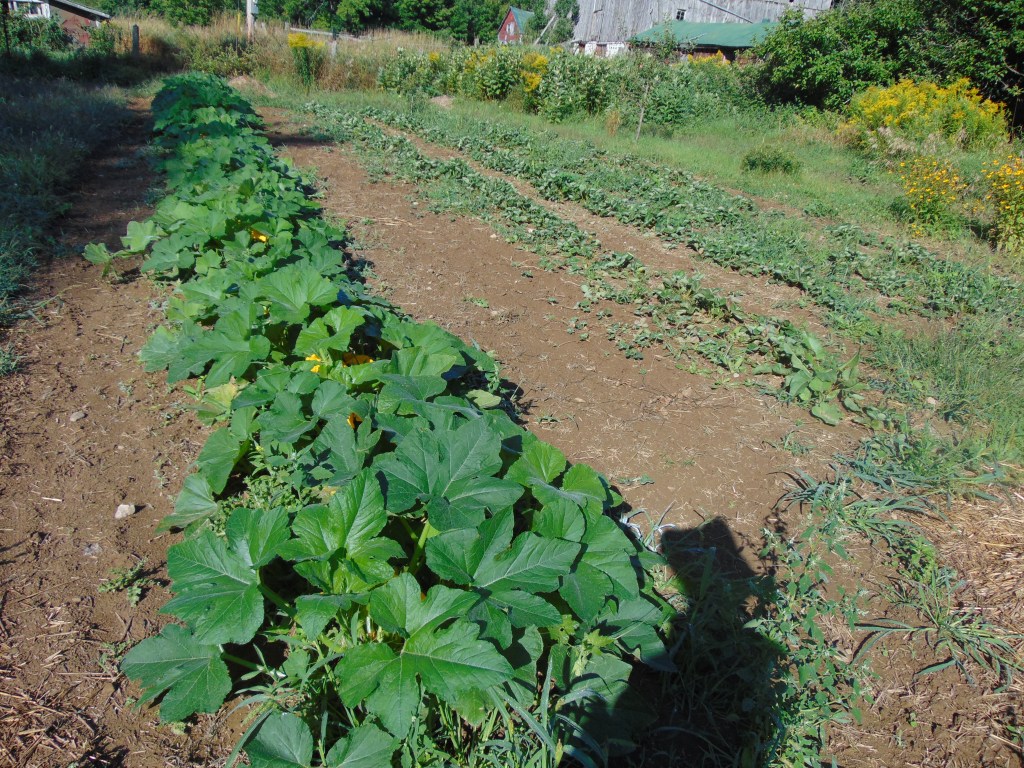
A row of transplanted ‘volunteer’ squash, hoping for a warm September

As many of my millions of readers will know, I live in anticipation of the next wonderful and often surprising moment.

They may not necessarily have global significance, except in so far as in that moment there could also be a meaningful message that might help someone on this still-beautiful, little planet get through their day and find hope for the future. And that is no small thing, after all.

And so, I offer this moment in my garden, leading possibly to yet more wonderful and surprising moments:

It began ordinarily enough: In early July I decided it was time to spread the compost pile that began during and after last years garden season as I worked the garden and to a large extent lived off the produce through the winter. The strawberry patch had finished producing, so I spread what appeared to be well-done compost in between the rows. About a week later I was amazed when I saw that hundreds of squash plants had ‘volunteered’ to germinate.

“Look at us,” I imagine them now crying out to me at the time, “we survived. We didn’t want to go off into the compost realm of being, however interesting it might be. We wanted to live again, as Squash.”

Now, you may wonder at the state of mind that considers such fancies. But in my dotage I have learned to let it “all hang out” finally, to have a little imaginative fun, when there’s no harm done. Call it freedom.

At any event, I let the volunteers grow, but was again amazed to see even more emerge, pushing their way through the crowd until it was obvious they would all soon make a canopy over the overwhelmed strawberry plants. So, I made a choice, first to thin the squash crowd, then transplant the best to a row of their own where I had planned a couple of new rows of strawberries as the runners from the existing rows spread that way. I reasoned that by the time the squash produced a late crop in September, assuming no early frost, that the ground would still be available for strawberries after the squash was harvested.

The other part of that reasoning was complicated by the fact I didn’t really know what to expect, regarding the type of squash the volunteers were likely to be. I had grown a couple of types of squash the previous season, including one I called my “weird” squash because it was derived from seeds I had saved from the 2020 season when I planted two varieties too close together and got a surprise hybrid that turned out to be remarkably colorful, and tasty, but hard to cut open.

So, “to make a long story short” as I say way too often, it remains to be seen what the volunteers will be. So far as I can tell from the fruit just starting to form, it looks like a butternut/acorn combination ‘winter’ squash.

Time will tell.

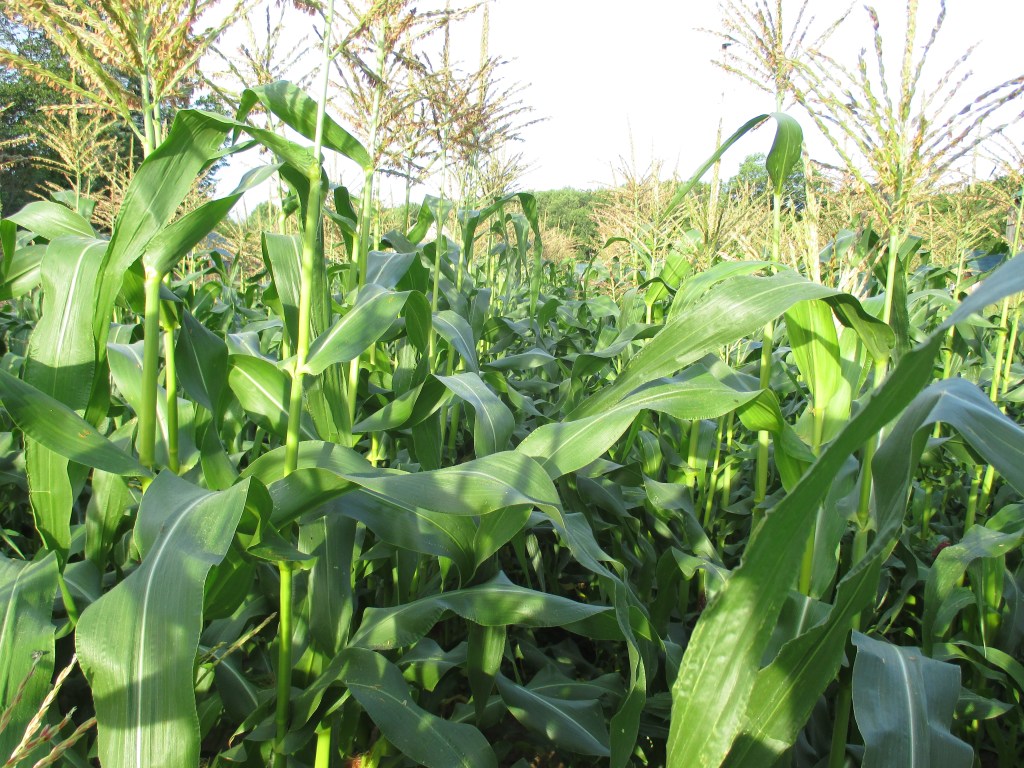
The original ‘peaches and cream’ sweet corn, non-GMO, Ontario Seed Company, ready to pick at Cathedral Drive Farrm

I find it very interesting to experiment in the garden like that, following an intuition not to get too carried away. There’s more than enough of that going on. Yes, of course, a good deal of selection has taken place over the thousands of years human beings have domesticated and naturally developed plants for consumption. But genetically engineering plants seems to me to be treading where we don’t belong. For example, vast quantities of corn, sweet corn included, have been bio-engineered with bacillus thuringiensis, a natural organism present in soil. In concentrated form it has been used, myself included, for years as an organic pesticide, harmless to humans, to control corn borer and corn earworms. They were not indigenous to North America, but once introduced accidentally years ago, there was always a big risk of a spoiled crop. But now, one of the problems with GMO-BT corn is – because “nature abhors a vacuum” – the sweet corn pests are already becoming immune to BT.

Speaking of squash again, squash bugs are a pest that often attack squash plants. I am very reluctant to use even organic, insecticidal soap to control them, mainly because I often see bumblebees and other pollinators feeding on the pollen of those beautiful, bright orange squash plants. So far this year, there doesn’t appear to be a serious squash bug problem in the several plantings of butternut squash and among the ‘volunteers.’

So, all things considered, I am looking forward to a wonderful squash harvest this fall.

Speaking of the back field and the nature of heritage

More than 40 years have passed since I came here to help the late Wilma Butchart and her son Cliff bring in the hay from that beautiful back field that reached out to the depth of their original 100-acre farm lot, with the mature hardwood forest on either side.

Wilma and Cliff were the first Hope Ness residents we met in June of 1979 when my then wife, Colleen, and I moved up from Toronto to Hope Ness. They welcomed us in the traditional way, with a gift of home-cooked goodness, a generous smile, and kind words. We became friends, and thanks to Wilma and Cliff we learned a lot about the history of Hope Ness, especially the Dow Chemical ‘takeover’ in the mid-1960s. (I have written previously about that in Finding Hope Ness at this link.)

Hope Ness was saved from the terrible fate of being turned into a huge quarry when Dow decided not to go through with its plans, and the Ontario government ended up owning the 2,000 acres (810 hectares) Dow had bought for a measly $5,000 acres per 100-acre farm. Most of the homes and barns had already been demolished, except for the Butchart farm, where Dow had set up its on-site base of operations. Wilma and Cliff continued to live there as tenants when the province took over ownership. Eventually, they managed to get title back to the house, barn other out-buildings, and 5.9 acres. They were also able to continue cutting and taking the hay off the back field to feed their livestock. That permit stopped eight years ago when Cliff passed away. Coincidentally, the province decided about the same time to stop issuing any more such permits on its Hope Ness land. That includes the Hope Bay Nature Reserve which surrounds the former Butchart home and property which I now own, and where I live.

I keep the hay cut on the small part of the back field I own. Beyond that I can see the new tree growth is now well underway. Already, that part where the forests on either side were nearest has begun to close, like a door on the past.

I remember being out there with them, Wilma driving the same Massey-Ferguson 65 tractor I’m still trying my best to keep in good shape, me tossing the bales up onto the hay wagon, and Cliff building the load. And so it went, back and forth to the barn to unload, for several days.

Invariably now, as I stand beside the barn and look out from there over that field as the trees and other seasonal-wetland vegetation take it over again, I also think about the years of back-breaking work that went into clearing that land. And also, the intense work that went into digging wells to help drain it, as often happened in those days. The most remarkable, where the back field begins, is a 20-ft deep well, carefully and expertly walled with stone and cement. That well also served as the main source of water for the house and pasturing livestock. It seems almost unimaginable, and yet I can see it after all in my mind’s eye: the men down below in the darkness, rocks and soil being hauled up by others. By the end of the spring run-off that well is always full to the brim. I use it to water my market garden as needed, which is often, this dry 2022 season especially.

The first house, later used for livestock.

All that work began in Hope Ness after 1880 when the first owner, John Heath, bought the 100-acre lot for “one hundred dollars,” according to the Crown Patent. Other Hope Ness settlers arrived about the same time from down south, or from ‘the old country.’ They had hopes; they had dreams; they worked their hearts out. For some it was too much to bear. Others stayed and survived, with more hard work that we nowadays can hardly fathom. Eventually, by the time the man from Dow showed up that fateful day, there was “a farm on every hundred acres,” as I heard it said in the summer of 1979. And even then, it was still a hard-scrabble, subsistence way of life. So, $5,000 must have seemed like a lot of ‘cash money,’ and maybe a once-in-a-lifetime chance for something better.

I do know that Wilma Butchart (Tucker), born and raised in Hope Ness, never wanted to leave. She loved this land, and the walk through what she called “the Cathedral Woods” to the lookout over Hope Bay, and Georgian Bay beyond. It was her refuge, her special place.

As a child and young woman born and raised on the nearby Tucker homestead, she loved to walk through the woods. She told me of seeing First Nation people from their nearby Nawash community across Hope Bay as they gathered edibles and natural remedies in those same woods. She spoke respectfully of that experience. I’m sure she would have joined them, being who she was. She certainly would not have thought it amiss in any way; on the contrary, she would have welcomed them.

As I look out across that field, I wonder also how much time it takes to have a true heritage, a feeling for a place, the land, the waters, that goes so deep it becomes an essential part of one’s being. Less than 100 years of non-Indigenous settlement had passed since 1880 by the time Dow showed up in the mid-1960s; and little more than 100 years since the Treaty of 1854 that opened the Saugeen Peninsula for settlement was signed under controversial circumstances. The era of settlement is not “since time immemorial,” it is fair enough to say.

And what of me? Am I, who wasn’t even born here, entitled to feel that I truly belong here, this place where I feel so much at home, which I love, as if it was always meant to be? Or is that a foolish thing to say, let alone think under all the circumstances?

I ask these questions sincerely, without any underhand motive. It’s just a question, from my heart to other hearts who know what it means to love their heritage.

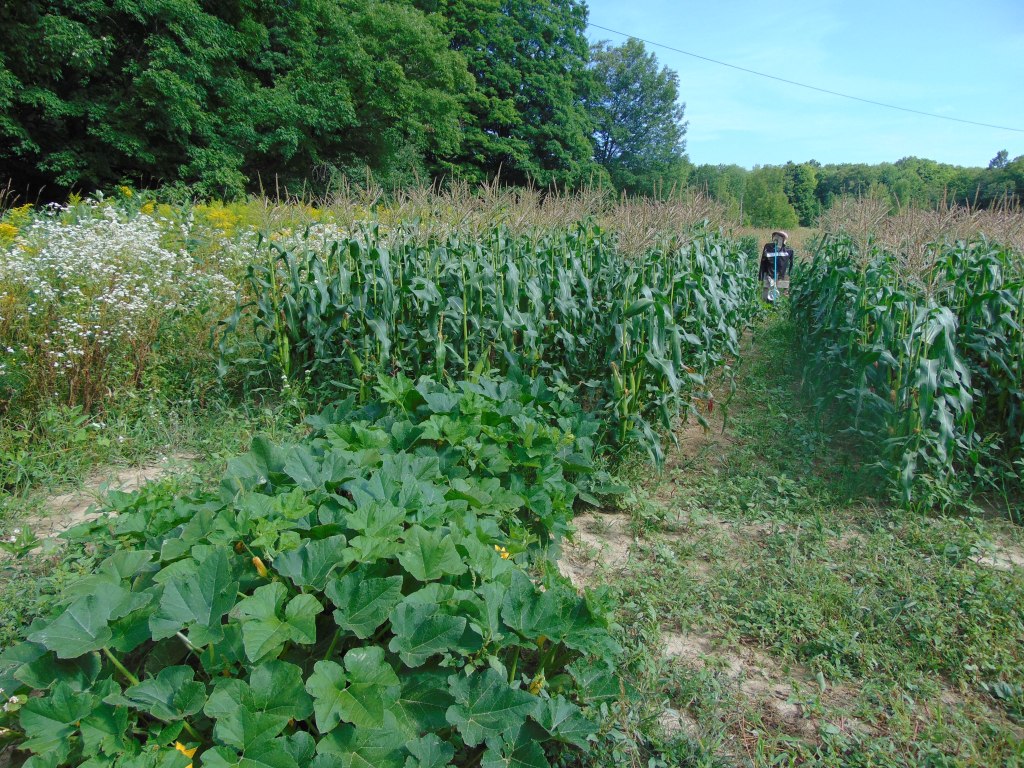
Corn, squash and beans growing in the front field, August, 2022.

On the hopeful resilience of gardening, and Lawrence O’Donnell’s interesting timing

In these most troubling times, with among other things the world’s first and greatest modern democracy in grave peril, I look daily to my garden for relief and consolation, and hope. I trust I’m not alone. Others, I know are doing what they can in their own way to keep their spirits up.

Every annual garden season in this little part of the world has its challenges; and the 2022 season has been no exception: unseasonably cool weather and drought in spring held held back the growth of plants started indoors then transplanted outdoors in late May. Seeds planted were slow to germinate. Many hours spent pumping and hauling water from two dug wells helped keep the garden in survival mode. When the rains finally came, it was never enough. A good soaking rain a week or so ago for a couple of days finally did wonders for the ‘three sisters,’ corn, squash and beans, and the prospect of Roma-type tomatoes for homemade pasta sauce.

But most of all I am again reminded of the determination of plants, and the strength of the life-force to overcome hardships, not the least of which is the heavy, clay-loam soil in these parts. Before the recent rain, when I set about to dig the first row of Yukon gem potatoes, I had trouble getting the digging fork into soil that seemed to have turned into virtual cement. And yet, there they were, good-sized plentiful tubers, showing only slightly the struggle it must have been for them to form. My habit of mulching with a generous depth of straw surely kept some moisture in the ground. But I give the potatoes most of the credit for their fortitude. Then came that soaking rain and the digging became easier.

Before the rain I was wondering how the sweet corn – the original, Ontario Seed Company, ‘peaches and cream’ bicolor – was ever going to fully develop and ripen. But within a few days, the development of the cobs was remarkable. And now I fully expect to have lots of corn ready for harvest by the end of the week, and on into the Labor Day weekend, and beyond, with a good, old fashioned corn roast to celebrate.

Likewise, the Roma tomatoes looked good alongside a bumper crop of Genovese basil, and another called ‘Sacred.’ That name reached out. I had to have it.

And so I am reminded again that hope, the appreciation of life’s rejuvenating powers, is the spiritual harvest of gardening and life. Good things can still and surely must happen. We must not give up.

By the way, for further context, I submit the following link that appeared on Youtube again a couple of days ago, with interesting timing regarding the recent Search Warrant that retrieved certain documents from Donald Trump’s home in Florida. The question has been asked what he might have done with them, or done already.

The Corn is up

Here, just south of the 45th Parallel (halfway to the North Pole) in the upper Great Lakes area of Ontario, Canada, the appearance of rows of little green sprouts of sweet corn in the first week of June is enough to make me break out into song and dance. I kid you not.

Corn has been described as a ‘tough crop,’ and so it is. But it’s also fussy: a warm-weather crop that won’t germinate if the soil temperature isn’t warm enough – a minimum of 21 degrees Celsius – and it won’t tolerate frost.

In southern Ontario, May 24 has traditionally been the date for planting such crops, on the assumption there’s no longer a risk of frost. But that’s not always dependable, as the 2021 growing season reminded us, when a hard frost a week after that date did a lot of damage; for example, annual strawberry crops then in pre-fruit flower, were wiped out in many locations, including mine.

Vast quantities of fungicides and other pesticides are used in modern, industrialized agriculture in the production of corn. Some fungicides are used to prevent seed corn from rotting after planting if the soil temperatures are not high enough to bring on germination for too long.

However, some growers, large and small, myself included, choose to use untreated seed. I think it’s fair to say that increases the risk of crop failure if after planting there’s a period of unusually cool weather. In my admittedly anecdotal experience, the weather in recent years has become less predictable, or reliable.

So, on May 17, with the weather and the soil warm, I knew I was to some extent taking a risk planting a few rows of sweet corn. But as a neighbor said, and I agreed, “sometimes you have to take a risk.”

A previous crop of sweet corn in Cathedral Farm garden

About a week later, after a nice rain, I was relieved to see those rows had emerged, and what’s more, showed 90 percent-plus germination. So, I took a deep breath and planted the rest of about 1.3 kilograms (just under three pounds) of seed – one seed, one row at a time, taking about eight hours in total. (Those single-row, push planters don’t work well with corn.)

And then, of course, the weather turned dry, and cool, though sunny. Fortunately, the soil embraced the heat of the sun sufficiently to keep the seed warm enough for germination; and then, a couple of days of much-needed rain was well-timed.

Watering by hand daily from a dug well will keep the garden alive. But there’s nothing like rain to turn it on. This morning is cool, but the whole garden is happy, virtually singing a chorus of relief and new growth as it, and I, look forward to a few days of sunny weather.

I’ll give the soil a chance to absorb the moisture for a day or two before weeding, and then laying down a thick bed of organic straw mulch for the strawberries, potatoes, and tomatoes.

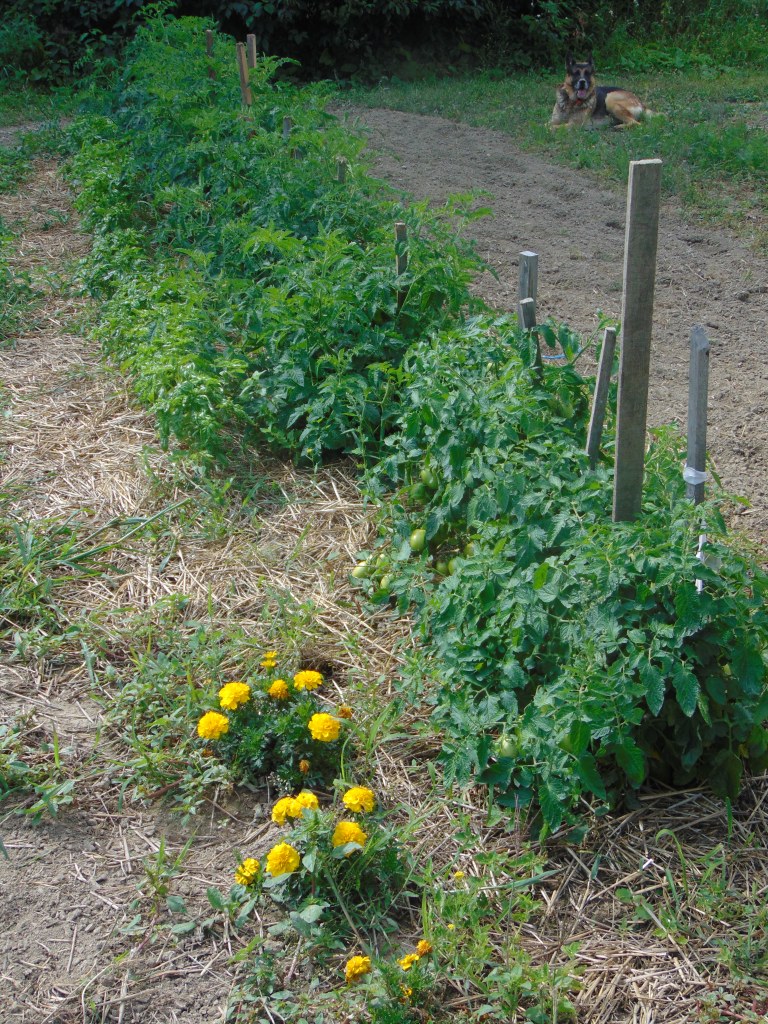
The mulch keeps the clay-loam soil moist and helps avoid the hard-pan problem. It also keeps the potato plants free of potato beetles and helps the tomato plants stay healthy.

Herbs, including lots of basil, as well as the classic, “parsley, sage, rosemary and thyme” are going to be transplanted into a new raised bed, as soon as the weather warms up a few more degrees.

I am reminded just now of something my grandson Daniel said a few years ago when he was here helping me plant corn. He stopped for a moment, looked over and said in a wonderful way, “you don’t think of anything else when you’re doing this, do you.”

“You’re absolutely right, Daniel,” I said. “There’s lots of great things about gardening; and that’s one of them.

I think of that now because of the terrible things happening in the world, that we surely need to be aware of, try to understand, and do whatever we can to help.

Being alive, trying to appreciate that as much as possible; planting and caring for a hopeful garden; loving and caring for family and friends, and especially for children; being there for a stranger in need; keeping spirits up; taking a moment whenever possible to love yourself, to give yourself a break. Yes, that too … all that and more. We cannot, we must not, lose hope about being alive.

Line 5: A Great Lakes disaster waiting to happen

The view of Hope Bay, with Georgian Bay in the distance, from a Bruce Trail lookout.

You could have knocked me over with a feather when I heard the propane truck backing down the driveway the other day. It hadn’t been that long ago, I thought, that I had the two tanks feeding the furnace filled up.

Turned out it was March 23, a month and a half ago, so it wasn’t that outlandish. Still, I was surprised, and told the driver I wasn’t sure I needed a fill-up. I was just about to turn the heat off for the season, with spring finally arrived after an unusually cold April.

And then he surprised me, to say the least, when he said, “there might not be any propane” come next fall.

“Oh, why’s that?” I asked. He said it was about the possibility something called “line 5” might be shut down by then. He explained that’s pipeline that brings oil and natural gas liquids from Alberta to Sarnia, Ontario by way of Michigan. Propane is a by-product, and if the line is shut down Ontario and Quebec, as well as Michigan and Ohio, would be faced with a severe shortage.

Meanwhile, the price of propane has, along with other fuels, greatly inflated in price this past heating season. With no indication that’s going to turn around any time soon, I chose rather reluctantly to get the tanks filled up despite the unexpected expense just then.

Coincidentally, just the day before I had been to the local gas station to get my 20-litre container filled up with diesel fuel for my tractor. I stopped at $40, not quite full. A year ago, that would have been $20.

The attendant muttered something about “Trudeau” and “pipelines.” The current inflation problem, regarding the price of oil in particular, is not a political problem, unless consumers think government should intervene in the free market, and then be accused of being dictatorial. It’s a supply and demand problem: as the economy bounces back from the covid-pandemic, economic slowdown in the past couple of years, the demand for oil and its byproducts is increasing. But producers are not ramping up supply fast enough to meet the demand while cashing in on the higher prices. Meanwhile, the war in Ukraine has also helped drive up the speculative price of oil, as war always does.

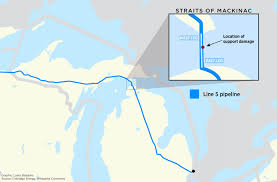
That’s bad enough. But as a long-time resident of the Saugeen/Bruce Peninsula and the Great Lakes region I was also shocked to learn a section of the 69-year-old Line 5 pipeline goes underwater as it crosses the Straits of Mackinac where Lake Michigan and Lake Huron connect. That’s up to 87 million liters of oil and natural gas liquids daily.

I should have known that a long time ago, of course. To be honest, in recent years as the owner a a propane furnace installed five years ago, I didn’t think much about where the propane came from. But now, all I can think is how utterly foolish it is that such a thing exists, and also how lucky the Great Lakes are that a catastrophe has not already happened. The fate of Line 5 is now before state (Michigan) and federal courts in the U.S., and also being discussed as a treaty issue between Canada and the U.S.

In November, 2020, Michigan Governor Gretchen Wittmer ordered the pipeline’s Canadian owner, Calgary-based Enbridge Energy, to shut down the underwater section of the Line 5 pipeline within 180 days. That action came after a state review of the state easement Enbridge obtained in 1953 allowing the pipeline to cross the straits underwater.

“Enbridge has imposed on the people of Michigan an unacceptable risk of a catastrophic oil spill in the Great Lakes that could devastate our economy and way of life,” Whitmer said in a statement at the time, as reported in an Associated Press story. “That’s why we’re taking action now, and why I will continue to hold accountable anyone who threatens our Great Lakes and fresh water.” 

Wittmer said over the years the company had persistently neglected requirements under the easement to properly maintain the safety of the line. Parts of the underwater line are not adequately supported, the state claims.

A statement currently on Enbridge’s website says the underwater section of the line was “built in 1953 by the Bechtel Corporation to meet extraordinary design and construction standards, the Line 5 Straits of Mackinac crossing remains in excellent condition and has never experienced a leak in more than 65 years of operation.”

“We’re working hard to keep it that way,” the statement continues. “We monitor the Line 5 Straits crossing 24/7, using both specially trained staff and sophisticated computer monitoring systems. We also carry out regular inspections of the line, using inline tools, expert divers, and remote operating vehicles (ROVs), going above and beyond regulatory requirements.”

Enbridge defied Michigan’s 180-day, shutdown deadline and took the state to court. The situation became more complicated when the question of which U.S. jurisdiction, state or federal, was more appropriate to hear the case. Then the Canadian government raised a treaty issue.

Meanwhile, Enbridge has a plan to rebuild the Straits of Mackinac section of the line, through a tunnel under the Straits, instead of above ground, underwater. The company has applied for a permit, which has so far not been approved.

There has been no public indication recently that the complicated situation may soon be resolved. It could be any day, or weeks, months, or years. The continuing uncertainty is troubling.

Let’s hope the condition of underwater pipeline is being closely watched by Enbridge, government agencies, and organizations concerned about the well-being of the Great Lakes.

Every day the Great Lakes have to wait for that aging, underwater pipeline to be shutdown is an obvious and unacceptable risk to the well-being of the precious lakes and the socio-economic future of millions of people on both sides of the border.

Seeds of hope in troubling times

The garden, May 2018

On a scale of one to ten this perplexing spring so far in Hope Ness and the rest of southern Ontario isn’t much to complain about when Putin’s bombs and missiles are killing thousands of innocent people in Ukraine, destroying the country, and threatening the future of the world

After Russia invaded Ukraine on February 24 of this year, I posted this brief comment on Facebook: “Suddenly, everything else is irrelevant,” without referring to Russia’s invasion of Ukraine. But the mostly local people who replied understood quite well what it was about. I sensed an unspoken, deep-seated anxiety about the increasingly unstable state of the world, one thing after another piled on in recent years: a persistent global pandemic; an attempted Trump-cult coup in the U.S. that only now are we learning how close it came to succeeding; democracy under threat by extremist, so-called ‘conservative’ movements in other parts of the western world, including Canada; hatred and divisiveness running amok.

And last, but certainly not least, climate change and its effects, being demonstrated, clear and ongoing, by this current spring in the upper Great Lakes area of Ontario and other parts of Canada.

At the time my ‘irrelevant’ comment felt right, and still does, depending on the outcome of the war in Ukraine. Just yesterday, April 26, 2022, Russian foreign minister Sergei Lavrov again raised the threat of nuclear war if Ukraine continues to ask for and receive military supplies from the U.S. and other NATO members. Russian President Vladimir Putin has previously made similar statements.

Lavrov said he would not want to see risks of a nuclear confrontation “artificially inflated now, when the risks are rather significant,” he said on Russia state television, as reported by the Associated Press. “The danger is serious. It is real. It should not be underestimated.”

It was an obvious threat, designed to keep the world at bay while the Putin Regime has its brutal way with Ukraine.

The most recent reporting says more than 8 million Ukrainians are now refugees, most of them women and children and old men. In a heartbeat, I would welcome them here at Cathedral Drive farm. And if they want to find some solace by helping in the garden, that would be fine. But no pressure. Sometimes a body needs to sit in the sun for a while, watch the clouds roll by, listen to the birds, go for a walk on the nearby trail, and rest.

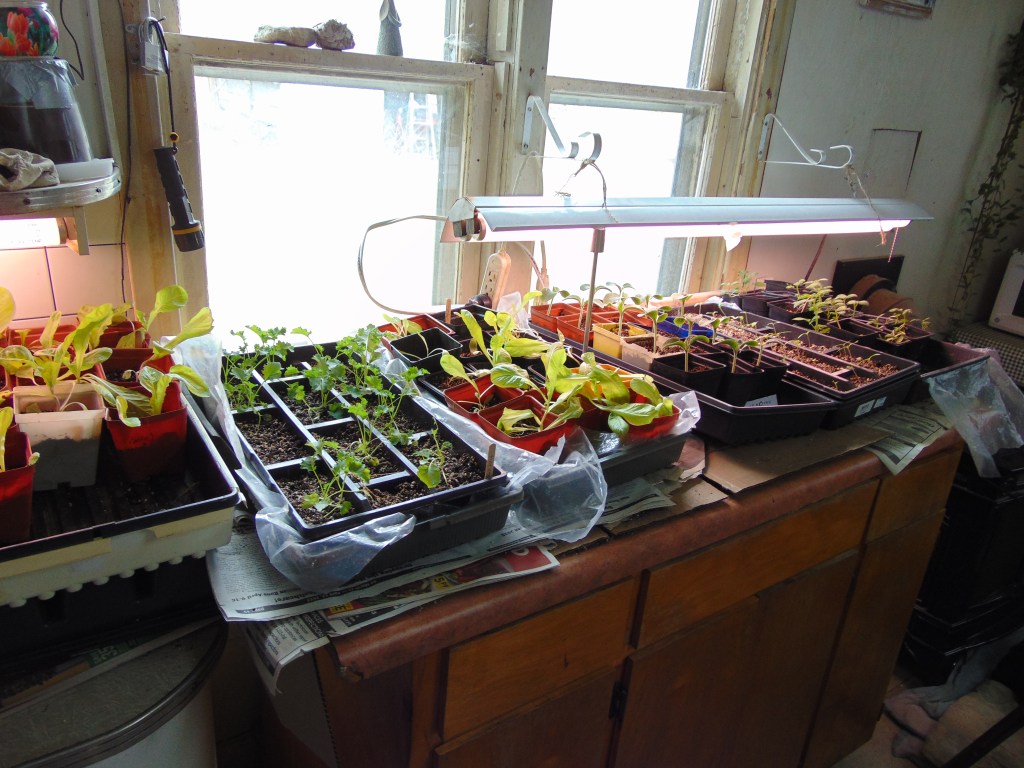
Seedlings waiting patiently to go outside, April 27, 2022

Hopefully, there will be an abundance of raspberries, strawberries, and vegetables from the garden by then. No matter where in this area refugees may go, I would be more than happy to gift them, and their hosts, with naturally grown produce from Cathedral Drive Farm. It would be a privilege.

The season is late so far this spring, to say the least. Last night, with the forecast calling for -3 Celsius temperatures I thought it best to bring the seedlings out of the cold frame and into the warm of the house. Now, April 27, early afternoon, the temperature is still struggling to get above freezing. Tonight, the forecast is for a low of -5 C, and -3 tomorrow night. This is not normal for the end of April. Southern Ontario is on the verge of setting a new April record for cold weather. Normally, by now potatoes, peas and other cool-weather crops would be planted; garlic and strawberries, their winter-straw blankets removed, would be flourishing in 10 to 15 Celsius temperatures. Instead, the soil is still too cold and wet to work. Maybe by the end of the week, with warmer though still unseasonably cool days ahead, and sun, precious sun.

Rows of garlic emerging slowly, -1 Celsius, April 27, 2022

Meanwhile, I just received word from a berry nursery in Quebec that their shipments have been delayed because of unprecedented cold, April weather there. I ordered 100 young raspberry plants to start a new, sunny patch in the back garden, and expected to plant them this week starting May 1. “Pas de souci. Je comprend,” I replied.

What’s going on, one might ask?

Climate change, that’s what – climate change that has weakened and disrupted high-altitude Polar Vortex and Jet Stream winds, allowing cold, arctic-air anomalies to dip farther south than what used to be called ‘normal.’ For some reason those anomalies have a particular liking for the Great Lakes region, and once down this way, they like to stick around.

Jet Stream map, environment Canada, April 27, 2022

Yes, colder springs may seem counter-intuitive when global warming is the root cause of climate change. The problem is the polar regions are warming at a greater rate, relatively speaking, than the tropics. And that fact, by the way, has also disrupted the warm-water Gulf Stream, so much that winters in the U.K and other parts of Europe are much more severe in recent years.

Hopefully, some day soon, the world will get the message that something needs to be done.

In the meantime, the best we can do is spread the word, try to do good, be caring and helpful where it’s needed most, and keep planting seeds of hope.

In praise of Russian culture: it deserves better

A scene from Ballad of a Soldier: a Russian mother waits for her son to come home from war.

I suppose this may not be the best time to say anything good about Russia and the Russian people. But no sooner do I write that than I think, on the contrary, this may be the best time.

The atrocious brutality of one man, and his corrupt enablers, whoever they are, have certainly cast a dark shadow over Russia and its people, who are apparently as gullible and easily manipulated as any nation of human beings on this long-suffering planet. Tragically, that appears to be one of the most fatal flaws of our imperfect species; otherwise, brutal, murderous tyrants, like Vladimir Putin, or would-be tyrants like Donald Trump would be laughed off the stage before they did too much harm.

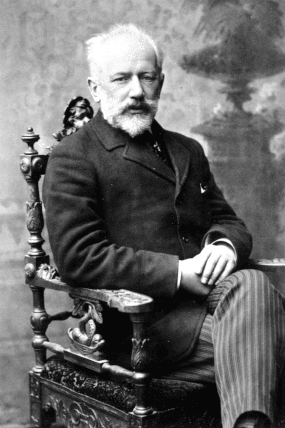
Tchaikovsky

Putin claims to be the Great Defender of everything Russian, including Russian culture. He references the current, conspiratorial ‘cancel culture’ mindset when he says Russian culture is in the process of being ‘cancelled’ by the west, led by the current U.S. administration under President Joe Biden. (No one should underestimate the extent to which Trump’s loss in the 2021 presidential election upset Putin’s grand plan for the takeover of Ukraine, including Trumps likely withdrawal of the U.S. from NATO).

But I dare to say, Russia, Russians, and Russian culture most of all deserves something a whole lot better than Vladimir Putin.

I hasten to say, I am not expert in Russian culture. What I know comes from personal experience and appreciation of the works of certain Russian composers, writers, and filmmakers. I can honestly say, from the heart, that my spiritual life has been enriched immeasurably, and my life changed, since the time I was a teenager by the listening, reading, and watching the great, creative works of the rich Russian culture.

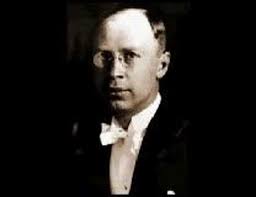
Sergei Prokoviev

I think I was 16 when I first heard Canadian pianist Glenn Gould play Sergei Prokoviev’s 7th Piano Sonata with the dramatic, ‘Precipitato’ final movement, like nothing I’d ever heard before. Thus began my life-long love of Prokoviev’s diverse, creative genius. He stands on a par in my book with Beethoven, possibly even higher; and, with the 9th piano sonata especially, he reached the sublime, ‘edge-of-the-universe’ musical expression of J.S. Bach at his best.

Again, as young man barely out of my teens, I saw my all-time, favorite movie on the unforgettable Elwy Yost’s, Saturday Night at the Movies, on TVO. Despite the less-than-ideal title in translation, the 1959 Russian movie, Ballad of a Soldier, is a classic of world cinema, with the most gorgeous and evocative musical score and wonderful cinematography. The scene at the well in the Russian railyard, when the heroine, holding back her long hair, drinks pure, spring water from a rough iron tap, is a life-lasting image. The hero, the young, Russian soldier, Alyosha, on leave for heroism, finally makes it home to his village with no time to spare. His mother finds out he is home almost too late, runs desperately through the field of grain, reaches the road as the truck carrying her son is driving away, then calls out to him, “Alyosha, Alyosha.” He hears her, but they have so little time to speak. Sixty years later it still brings tears to my eyes.

Scene from Ballad of a Soldier

How many Alyoshas, kept in infernal, misinformed darkness by Putin, died in Ukraine today, I wonder.

Most recently, my new most favorite movie is The Ascent, by Larisa Shepitko, regarded as one of the best women directors in the history of cinema, Shepitko was born in the eastern Ukraine. Her father was Persian. She went to Moscow when she was 16 to study filmmaking and immerse herself in the former Soviet Union’s rich, though tightly controlled, cinematic tradition. For example, Sergei Eisenstein (Battleship Potemkin, 1925, Odessa Steps scene) is regarded as one of the greatest formative directors in film history.

Made in 1977, two years before Shepitko’s tragic death in a car accident, The Ascent follows the fate of two Russian partisan’s as they try to find their way back to their group through the bitter cold of a Russian winter after ambushing a German patrol. They reach a farm where they are given shelter but are discovered and taken to a nearby village. They are sentenced to hang along with a group of villagers. After torture, one of the partisans agrees to work for the Nazis to save his life. The other partisan goes to his death with courage and Christlike faith. It is one of the most deeply moving movie scenes I have ever watched.

A scene from The Ascent

The historic Ukraine-Russia connection, early and late, is complicated, and forged on the crucible of frequent, foreign invaders, notably, Mongols, Napoleon’s Grand Army, and Germany’s Nazi regime. It’s no wonder a good deal of paranoia underlied the empire-building policies of Tarist Russia, the former Soviet Union, and now Putin’s Russia.

Ukrainians suffered greatly during the mid-1930s under Joseph Stalin’s brutal, dictatorial leadership of the Soviet Union. Millions of Ukrainians died of persecution and starvation as a result of famine deliberately engineered by Stalin. Whatever brotherhood may have existed between Russia and Ukraine before then was destroyed by Stalin’s brutality, much like Ukraine is now, again, being destroyed by Putin.

Thus have the evil deeds of two, ruthless dictators led to the current war in Ukraine, and the real possibilty of a global catastrophe. The Ukranian people deserve better. So do the Russian people. And so does the world.

You would think ‘in the best of all possible worlds’ the historic suffering of both the Russian and Ukranian nations would lead them to a mutual understanding of how to live in separate, sympathetic peace.

But this is not the best of all possible worlds, so long as autocratic tyrants are allowed to take and hold absolute, undemocratic power.

The lies that brought us to the brink

A classic ‘picture worth a thousand words.’

Donald Trump (DT), the well-known pathological liar and former President of the U.S.A. who tried but failed to overthrow its democracy has blamed President Joe Biden for Russian dictator Vladimir Putin’s ongoing military invasion of Ukraine. But the well-documented record of the last six years shows DT has done more to weaken the U.S. than anyone in its history, while constantly acting as Putin’s ‘useful fool’ puppet, with the help of so-called ‘conservatives’ in the U.S.

I say ‘so-called’ because since when is enabling and supporting social-political disruption and hateful division in one’s own country conservative. In fact, it is knowing or unknowing traitorous behavior that has enabled Putin’s plan to restore the Russian/Soviet empire and emboldened him to attack Ukraine.

Meanwhile, the self-centered DT stands on a public stage before a rapturous audience of several thousand useful-fools, so-called conservatives, and millions of gullible members of his cult, and calls Canada’s Prime Minister, Justin Trudeau, a world-class “tyrant.” And for what? For being patient for weeks? For repeatedly asking protestors occupying the nation’s capital to go home, before defending our country against the imported cult of disruption and chaos trying to destroy Canadian democracy in the name of ‘Freedom?’

It boggles the mind that this is what the world has come to: the continuing human tragedy of millions of people being taken in by the lies and hypocrisy of two madmen drunk on power. And as a result, the existential future of the world is at stake; especially now that Putin has raised Russia’s immense nuclear power to a state of imminent readiness.

It is utter madness in a world in which most people simply want their children and grandchildren to have the hope of a peaceful and secure future in which to live.

One morning in the spring of 2016, I was out in my garden hilling rows of recently emerged potato plants. The sun was shining, a few clouds were drifting by in the sky above. I was full of thoughts about why DT, still not formally chosen the Republican Party candidate for the U.S. presidential election that year, would suggest the North Atlantic Treaty Organization (NAT0) was obsolete. And, besides, he said, most NATO members don’t pay their fair share of NATO funding, unlike the U.S..

I asked myself, why would he say that now, just two years after Putin’s Russia had invaded and annexed the Crimea, then part of Ukraine, and with Russia conducting a clandestine war in eastern Ukraine in support of separatist rebels. The former Soviet republics that joined NATO after the fall of the Soviet Union were understandably alarmed by those signs of renewed Russian aggression. Wasn’t the U.S. supposed to be their allies?

As a political move aimed at gaining support from members of the Republican Party, what DT said also didn’t make sense. The party had long been a staunch opponent of the former Soviet Union, and prior to the 2016, of Putin’s Russia. So, what was he thinking?

I put down my hoe, looked up at the sky and suddenly saw the light. “He’s got a deal with the Russians,” I said to myself. Call it a hunch: at the time that’s what it was, based on what I knew.

I comforted myself by thinking that, if it was true, the truth would surely come more to light, one way or another, and the ‘smoking gun’ found.

Granddaughter Mirabella helping Grandpa hill potatoes, spring 2016.

Nothing that happened leading up to the 2016 election and after has done anything to change my mind about my thoughts then. On the contrary, I believe now more than ever DT had a ‘deal with the Russians,’ and maybe still has. Certain things that happened over the past almost six years continue to stand out amid BT’s generally fawning attitude toward, and praise of Putin: the Helsinki summit with Putin, for example, whereby DT dismissed the conclusions of the U.S. official Intelligence community that Russia had interfered in the 2016 election. After a secretive close-door session with Putin, the then-President of the United States said Putin had ‘strongly’ denied anything of the sort had happened. Commentators in the U.S., many of them former high-ranking government officials and military officers, were astounded, “I never thought I’d see the day” when a President of the United States would ever say such a thing, said one.

Throughout his one-term tenure, DT continued to say time after time, and still does, that the whole “Russia thing” was a “hoax.” It was not.

The investigation led by Special Counsel Robert Mueller only happened because former U.S. Attorney-General, the late Jeff Sessions, recused himself from the probe into the possibility of Russian interference in the 2016 election, and the possible collusion of DT’s 2016 election campaign. Rod Rosenstein, Session’s deputy A-G at the time appointed Mueller to head up the investigation in May, 2017.

The final Mueller Report found plenty of evidence of interference by Russian government agents and operatives. A Grand Jury for the District of Columbia (D.C.) charged a dozen Russians with criminal offences, including Conspiracy to Commit an Offense Against the United States. They have never been arrested and are likely hiding in plain sight in Russia.

Mueller himself said the reason DT was not charged with Obstruction of Justice was because of a Department of Justice policy against charging a sitting president with a criminal offence.

Bill Barr, who was Attorney-General when the Mueller report was about to be made public, took pre-emptive action by writing and releasing a summary that appeared to exonerate DT, who quickly seized on the moment to claim again that it was all a “hoax.” Partly as a result, 75 million Americans voted for DT in the 2020 presidential election. He still lost by seven million in the popular vote, and also by a wide margin in the electoral college, as confirmed by Congress on January 6, 2021. That was despite a riot by DT supporters who breached the capital in hopes of disrupting the process. To this day DT still claims the election was “stolen” from him.

To his credit, Attorney-General Barr, after ordering a DOJ investigation, said no serious evidence of election fraud was found. And then he resigned after DT’s angry reaction to that.

The Guardian published an interesting article last summer that I recently re-read. The Guardian is widely respected as one of the best news venues in the world. The carefully worded article cites “what are assessed to be leaked Kremlin documents” that indicate Putin personally approved a secret Russian plan in January, 2016 to support what the leaked papers describe as a “mentally unstable” DT in the 2016 US presidential election

The leaked document speaks of it being “acutely necessary” to take strong measures to facilitate DT’s election as U.S. president. That would help bring about Russia’s favoured “political scenario” because a Trump win “will definitely lead to the destabilisation of the US’s sociopolitical system, and see hidden discontent burst into the open.”

Some of the measures Russia might take to infect American public life with media viruses” would become self-sustaining as they mess with the “mass consciousness” of certain groups of Americans, the Kremlin paper says, as quoted by the Guardian.

Spokespersons for both Putin and Trump strongly denied at the time there was any truth to what the Guardian article said.

It is worth mentioning here though, that if there was indeed such a plan, that it certainly succeeded, beyond Putin’s wildest dreams. The fate of U.S. democracy is still in jeopardy.