I am reminded this morning of something my late mother told me more than once, about when she and her grandmother (adoptive mother) went for a long walk one day in their west Toronto area when Mom, born in 1920, was still a young girl. They saw a sign on the gate of a large industrial company, Dominion Bridge. The sign said the company was hiring; but it also said, “Scots and Irish need not apply,” as my mother recalled.
By that time, Scots and Irish, made up the largest ethnic groups in Toronto, and most were second or third generations sons and daughters of immigrants, many of them Scots-Irish from Ulster, or Northern Ireland. Yet still, vestiges of the Anglo establishment of the 19th Century, clung to their sense of cultural and political superiority. Unfortunately, such is the experience and fate of every wave of new immigration. Yet, many of them in turn show the same unwelcoming attitude toward the next waves of immigrants.
What’s happening now in Springfield, Ohio, USA, is typical. Meanwhile, there have always been low-life politicians who take unprincipled advantage; but not to the terribly tragic extent now taking place in the context of the U.S. Presidential election. It is not only the fate of the world’s once-greatest democracy at stake: the whole world is ‘on the edge.’
As I began to look at the on-line news in the very ‘wee hours’ of this morning, The headline of a CBC Radio Canada article soon caught by eye: “Millions of people in Canada have sleep apnea. The problem is not all of them realize it.”
Indeed, “not all of them” was putting it mildly, when that was followed by this sub-heading: “Roughly 8 out (of) 10 with sleep apnea are undiagnosed.”
The article cites a 2014 study by Canadian medical experts. They cited information gathered by Statistics Canada indicating an estimated 5.4 Million Canadian adults had been diagnosed with sleep apnea or were at high risk of experiencing obstructive sleep apnea.
Sleep apnea is a condition in which breathing stops and restarts often many times during sleep. When that happens the heart has to work harder to keep pumping vital oxygen-rich blood to the body. Over time that can lead to heart problems. Meanwhile, there’s always the risk a person with sleep apneal won’t start breathing again.
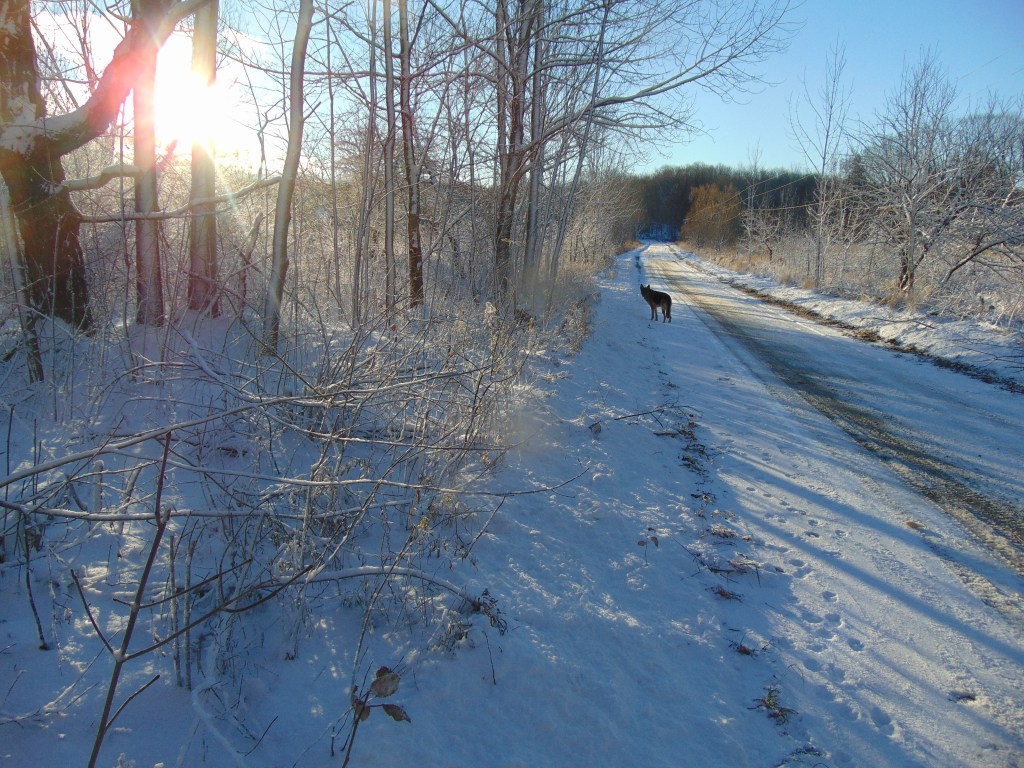
Sunrise on Cathedral Drive is always inspiring. That’s my Shepherd, Buddy. Just because.
So, if someone says, or perhaps complains, you snore and gasp in your sleep, you may want to consider seeking medical advice; or also, if you experience other symptoms of poor quality, or lack of sleep, like excessive tiredness and lack of energy during the day. The latter has become the story of my life in the past year as I struggle, so far unsuccessfully, to master the art of using what the CBC article calls the “first-line, gold-standard” treatment for sleep apnea, the CPAP machine
More about that in a moment; but first, the basics. The U.S. National Library of Medicine has one of the best, brief descriptions of the two types of sleep apnea, obstructive sleep apnea (OSA), and central sleep apnea. OSA “happens when your upper airway becomes blocked many times while you sleep, reducing or completely stopping airflow. This is the most common type of sleep apnea. Anything that could narrow your airway such as obesity, large tonsils, or changes in your hormone levels can increase your risk for obstructive sleep apnea. Central sleep apnea happens when your brain does not send the signals needed to breathe. Health conditions that affect how your brain controls your airway and chest muscles can cause central sleep apnea.”
I get the impression central sleep apnea is a relatively new area of study, but to be honest I don’t know, and maybe my memory has failed me on this point; but I don’t recall ever being told which type of sleep apnea I have, despite having had three overnight sleep lab tests, all of them in Owen Sound. The last one was mid-October, 2023. So far there are no results, and no telling how long I will wait to hear from a specialist to discuss them. I waited a year after my second overnight test about five years ago. I take that to be a measure of the level of demand. When I had my first test, the technician told me I woke up briefly 40 times because I had stopped breathing, but I had no memory of that happening. Fortunately, my brain took charge and pushed the figurative ‘restart’ button. And that was called “mild, to moderate” sleep apnea.
After the second sleep test, I was prescribed to go on a CPAP (continuous positive airway pressure) machine, after a trial run of a week when it seemed to work for me. With a constant level of measured, pressurized air going from the machine to your airway, the system is designed to take keep you breathing if you stop. And you will, that is a given with sleep apnea.
But, despite the encouraging start, there was a problem, though the machine itself was working properly when tested. I tried different remedies, including going from a nasal to a full mask (nose and mouth) and still the problem continued: waking up after an hour or two with a very dry mouth and throat.
Turns out this problem, getting used to the CPAP machine, is not unusual: Forty percent or more of people who start, give up on it; but that should not be an option.
I confess I gave up for a while, but, realizing the risk I was taking, tried again, and again. And I’m still trying, as my sleep quality has continued to worsen. Recently, I bought an oximeter device, as a kind of ‘back up’ just in case. Made to fit like a ring on suitable finger, the device keeps track of blood-oxygen level and heart pulse. One of the risks of sleep apnea is that the heart has to work harder to keep pumping oxygenated blood when breathing stops. If the blood-oxygen level goes below a set percentage – I’ve set mine at 92 percent – the device has a vibration-alarm that is supposed to ‘gently’ alert you to restart breathing, but not necessarily wake you up. I’ve got the alarm set a ‘very strong’ but still it doesn’t consciously wake me up. Fair to say, I think, it’s not a good idea for the hard of hearing. So, time to get hearing aids after all, I guess, ASAP.
The ring-device comes with a smart phone or computer app which, when connected to the device shows the ups and downs of your blood-oxygen and heart pulse. That has been interesting and eye-opening, especially when the blood-oxygen level has gone below 90, before recovering, which has happened a few times. That’s troubling, but better to know than not.
To summarize, my sleep apnea has recently become life-changing: tired during the day, while trying to catch up by napping one or more times; and worst of all, lack of energy, having to push myself to get doing what came so easily even up to a year ago.
That’s not the way I want to live; but I am determined to find a way to overcome this sleep apnea challenge. And when that happens, I’ll be sure to let you know.
The lead article in the Washington Post’s ‘Todays Worldview’ about the earth-shattering disaster under way in the world’s greatest democracy should be read and understood by everyone on Earth who cares about the future, peace, and stability of human life.
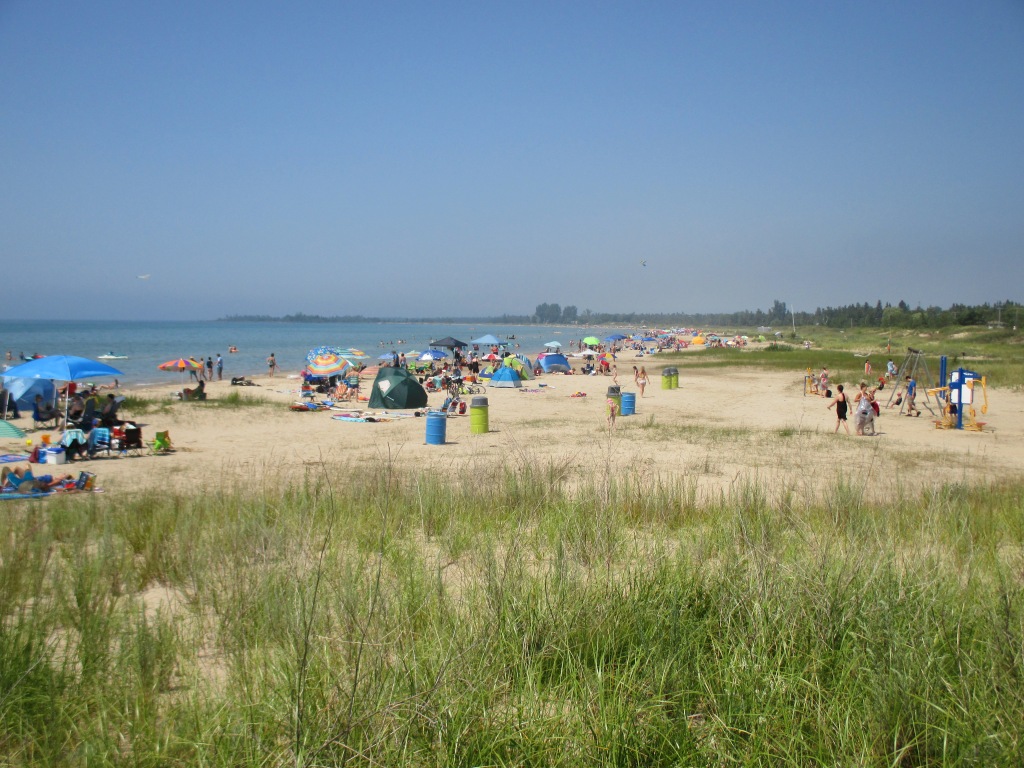
The recent Ontario Superior Court decision confirming the Saugeen First Nation’s rightful ownership of the north section of Sauble Beach is in itself an important milestone in Canada’s path toward meaningful reconciliation with Indigenous people.
Possibly just as significant in the future is the potential for a new, or renewed, era of improvement and development in all aspects of Sauble Beach’s well-being. Above all, that would include protection of the natural environment, and a new vision of future development that honors the longstanding First Nation presence and the principle of reconciliation.
I say ‘potential’ because it all depends on how open to, and how well, the indigenous and non-indigenous communities work together to make it happen. In other words, will there be peace and reconciliation, and cooperation for the overall good of the beach and both communities? The answer to that question will be nothing short of a litmus test for the future of Canada, as well as the future of Sauble Beach. There is far more to be gained by thoughtful cooperation than resentful confrontation.
Such an approach could be applied to the most mundane aspects of Sauble Beach’s future, as well as the most noble. One thing that comes readily to mind is Sauble Beach and the surrounding communities are long overdue for water and sewer services. The Saugeen First Nation and the Town of South Bruce Peninsula may want to put their heads together and join forces as soon as possible to call upon the federal and provincial governments’ help to make that a Sauble Beach development priority.
The court decision has set the stage for an interesting, new dynamic: the interface of an Indigenous community with considerable experience hosting non-indigenous tourists and cottagers on its territory, now sharing with a municipal government the well-being of a major tourist attraction and the mostly non-indigenous, business and residential community built around it. Respectful cooperation is surely the order of this new day.
In all the circumstances, and considering what’s at stake, it’s a wonder the long-standing, Saugeen land-claim didn’t get far more news media coverage and public attention before news of the court decision broke early this month.
The case, based on the Saugeen First Nation’s long-standing claim of ownership, has been before the Ontario court since 1995, but its roots go back 169 years: Treaty 72 was signed under controversial circumstances on October 14, 1854, after a hastily arranged day of intense negotiations engineered by Laurence Oliphant, the newly-appointed Superintendent General of Indian Affairs for Colonial Canada. Oliphant warned the Saugeen Ojibway (Chippewas of Nawash and Saugeen first nations) chiefs that the Crown might not be able to keep squatters out of their Saugeen Peninsula territory as he pressured them to surrender most of it. Yet, later the same day, after the treaty was signed, Oliphant posted a public notice and ordered the Owen Sound-based sheriff to keep squatters out of the newly-acquired Crown territory. The peninsula was soon renamed the Bruce Peninsula after a colonial official who had never been there. The Saugeen Ojibway were to be left with a few relatively small reserves, including the Saugeen First Nation reserve on the Lake Huron shoreline from the Saugeen River to Chief’s Point at the mouth of the Sauble River north of Sauble Beach.
Prior to the recent court decision, the Saugeen First Nation had long claimed the survey done two years after the treaty was signed did not correspond to the intent of the treaty. Ontario Superior Court Judge Susan Vella agreed in her finding that the honor of the Crown had been brought into disrepute by the mistaken survey, and the Saugeen First Nation was the rightful owner of that north portion of the beach that has been under local municipal jurisdiction for many years. Meanwhile, the southern portion of the beach, south of the iconic Sauble Beach signpost, has been Saugeen territory since after Treaty 72 was signed and surveyed.
There was an opportunity for a negotiated settlement of the Saugeen First Nation claim of ownership of the north section of the beach in the summer of 2014. With the support of Canada’s federal government Justice Department, and if its ownership of the disputed section of the beach was recognized, the First Nation was prepared to enter into a co-management agreement with the Town of South Bruce Peninsula; but that deal ran into a fire-storm of public opposition from many in the largely non-Aboriginal community of Sauble Beach when it was presented and discussed at a public meeting in August, 2014; and as a result the court case continued unresolved for another almost nine years.
That was an opportunity lost; but another, similar opportunity presents itself now.
South Bruce Peninsula council has chosen to file an appeal of the April 3 court decision; but it appears to be focused on clarification of the western boundary between the newly confirmed Saugeen territory and the municipality, and the status of private property on or near the north section of the beach. Fair enough; but it’s time to move on to that new opportunity.
Kind-hearted RCMP officers welcome refugees to Canada at an irregular border crossing a few years ago
File this under ‘How soon we forget the lessons of shameful history,’ including one of the most shameful events in Canadian history.
In thinking about changes to the Safe Third Country Agreement, announced this past week during U.S. President Joe Biden’s official visit to Ottawa, I was soon reminded of the S.S. St. Louis tragedy.
With 937 937 passengers on board, the German-owned, ocean liner left the port of Hamburg, Germany on May 13, 1939, bound for Cuba. Almost all were Jewish refugees fleeing persecution, death, and violence in Nazi Germany. The so-called ‘Nuremberg laws’ of 1935 had stripped Jewish Germans of their citizenship and civil rights. For a while, the 1936 Olympics in Berlin, delayed some of the worst anti-Jewish persecution; but especially after Kristallnacht (literally, the “night of Crystal,” more commonly known as the “night of broken glass,”) a two-day, anti-Jewish, hate-orgy of violence in November, 1938, the persecution became much worse, deadlyand ominous.
“The German Foreign Office and the Propaganda Ministry also hoped to exploit the unwillingness of other nations to admit large numbers of Jewish refugees to justify the Nazi regime’s anti-Jewish goals and policies both domestically in Germany and in the world at large,” says an article titled, Voyage of the St. Louis, on the United States Holocaust Museum article website.
The Nazis must certainly have been pleased by the extent to which their hopes were realized. First, Cuba, refused to let the Jewish refugees disembark in Havana, despite earlier approval and the issuing of landing and transit documents, then the United States; and finally, Canada said, in effect, no way.
Before the St. Louis left Hamburg, it attracted a lot of news attention, especially in Cuba, where right-wing newspapers “deplored its impending arrival and demanded the Cuban government cease admitting Jewish refugees,” says the Holocaust Museum article.
“Reports about the impending voyage fueled a large antisemitic demonstration in Havana on May 8, five days before the St. Louis sailed from Hamburg. The rally, the largest antisemitic demonstration in Cuban history, had been sponsored by Grau San Martin, a former Cuban president. Grau spokesman, Primitivo Rodriguez, urged Cubans to ‘fight the Jews until the last one is driven out.’ The demonstration drew 40,000 spectators. Thousands more listened on the radio.”
The passengers became victims of bitter infighting within the Cuban government. They weren’t told before the St. Louis left Hamburg that Cuban President Federico Laredo Bru had issued a decree invalidating all recently-issued, Cuban landing certificates.
The St. Louis reached Havana on May 27, 1939. Cuban officials allowed 28 passengers to disembark: 22 were Jewish and had valid U.S. visas. The other six were Spanish citizens and Cubans with valid documents. One passenger who tried to commit suicide was allowed ashore to be taken to hospital. Another person had died of natural causes on the voyage. The remaining 908 Jewish, refugee passengers carried documents issued corruptly by the Director-General of the Cuban Immigration office, Manuel Benitez Gonzale, and no longer valid. Of those, 743 had applied for but were still waiting for U.S. immigration visas. The ship’s Captain, Gustav Schroder, refused to leave Havana Harbor; but talks aimed at allowing the refugees to disembark failed. On June 6 President Bru ordered the St. Louis to leave Havana harbor.
Capt. Schroder took the St. Louis slowly north in hopes the U.S. would allow the refugees ashore at one of the many ports on the eastern seaboard.
“Sailing so close to Florida that they could see the lights of Miami, some passengers on the St. Louis cabled U.S. President Franklin D. Roosevelt asking for refuge. Roosevelt never responded,” according to the Holocaust Museum article. “The State Department and the White House had decided not to take extraordinary measures to permit the refugees to enter the United States. A State Department telegram sent to a passenger stated that the passengers must “await their turns on the waiting list and qualify for and obtain immigration visas before they may be admissible into the United States.”
Apparently, some things never change:
“Both of our countries believe in safe, fair and orderly migration, refugee protection, and border security. This is why we will now apply the Safe Third Country Agreement to asylum seekers who cross between official points of entry,” Canada’s Prime Minister, Justin Trudeau said at a news conference during U.S. President Biden visit, the CBC reported. “After midnight tonight, police and border officers will enforce the agreement, and return irregular border crossers to the closest port of entry with the United States,” Trudeau added.
As the St. Louis continued north toward Canada, a group of prominent citizens petitioned Prime Minister Willian Lyon Mackenzie King to offer the refugees sanctuary. He passed it off to other high-ranking officials, including Minister of Justice Ernest Lapointe, and Frederick Blair, director of Immigration, according to The Canadian Encyclopedia:
“Lapointe was ‘emphatically opposed’ to admitting the refugees, and Blair argued that they did not qualify under current immigration laws – laws he had created. ‘No country,’ according to Blair, ‘could open its doors wide enough to take in the hundreds of thousands of Jewish people who want to leave Europe: the line must be drawn somewhere.’”
“At the time religious intolerance and antisemitism were common in Canadian society and even in its cultural and political leaders — right up to Prime Minister William Lyon Mackenzie King,” The Encyclopedia Canada article says. It goes on to quote from King’s private diary entry from March 29, 1938:
“We must nevertheless seek to keep this part of the Continent free from unrest and from too great an intermixture of foreign strains of blood, as much the same thing as lies at the basis of the Oriental problem. I fear we would have riots if we agreed to a policy that admitted numbers of Jews.”
In fact, one of the worst anti-semitic riots in Canadian had already happened in the summer of 1933 in Toronto, soon after the Nazi (National Socialist German Workers’) Party had made Germany a one-party, fascist dictatorship under its leader (Fuhrer) Adolf Hitler. The Christie Pits Riot on August 16, of that year, “remains one of the worst outbreaks of ethnic violence in Canadian history with over 10,000 participants and spectators,” says The Canadian Encyclopedia. “The riot was sparked by Nazi-inspired youth flying a swastika flag at a public baseball game to antagonize and provoke Jewish Canadians.”
With no sanctuary found, the St. Louis returned to Europe, docking at the Port of Antwerp, rather than Hamburg, Germany. With the help of a Jewish charitable organization, Great Britain took 288 passengers, the Netherlands 181, Belgium 214; and 224 found at least temporary refuge in France. Of the former refugees who found sanctuary in Britain, all survived except one who died in a 1940 air raid. Of those left on the continent, 254 died in the death-camps of the Holocaust.
In retrospect, it’s easy enough to see that under the circumstances at the time, and well-documented history as it is now known, Jewish refugees desperately trying to escape Nazi Germany just before the start of the Second World War were in urgent need of extraordinary, life-saving help. And if that meant that the usual bureaucratic process and rules needed to be set aside, so be it. That anti-Jewish racism played such a role in Canada’s failure to help save Jewish refugees remains shocking and shameful.
The world is now facing a similar humanitarian challenge with immensely tragic consequences as multiple crises arise: wars, the increasingly extreme effects of climate change; and most troubling, the resurgence of hateful regimes that exploit the worst of human nature and its fears: even in the most civilized of nations, including the world’s first and greatest liberal, modern democracy. It’s as if the world is going mad.
Meanwhile, millions of innocent victims have little or no access to bureaucratic processes: all they can do is try to escape one desperate way or another at the risk of their lives.
And if that takes them to Roxham Road, in Quebec, Canada, near the border between Canada and the U.S., or for that matter any other so-called illegal refugee entry point, are they somehow unworthy of being helped, saved from their fate, and thus “sent back?” To What?
Scottish refugees from ‘the clearances’ waiting to board a ship to Canada
To a large extent, Canada itself was made of such people: refugees from a genocide we of a certain age never heard of in schools: The Clearances, whereby Scottish highlanders, tenant farmers called Crofters, were forced, burned out of their homes on Anglicized, aristocratic estates to make way for sheep herds and deer yards. Eventually those refugees, the remnants of the McNichol clan included, found there way on poor ships to Canada.
The same for Irish refugee immigrants, victims of the devastating, mid-19th Century potato famines in Ireland. Many died on the poor ships. Orphan children were adopted by Quebecois families – hence, the prevalence of the name ‘Johnson,’ for one, to this day in many Quebecois families.
Nowadays, I suppose that might be called ‘Critical Race Teaching.’ It’s the truth, and it deserves to be known, and not forgotten.
Let’s have a heart after all, when the times demand it. There’s a better way than closing doors or building walls.
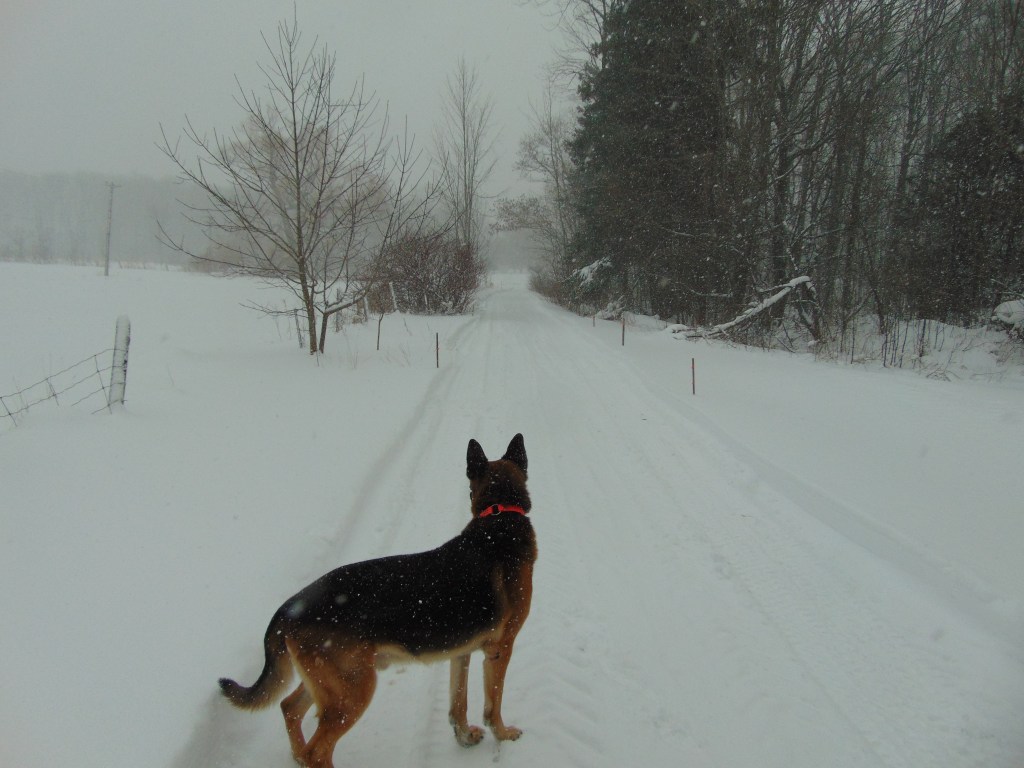
Two essential members of the family on a snow squall warning day
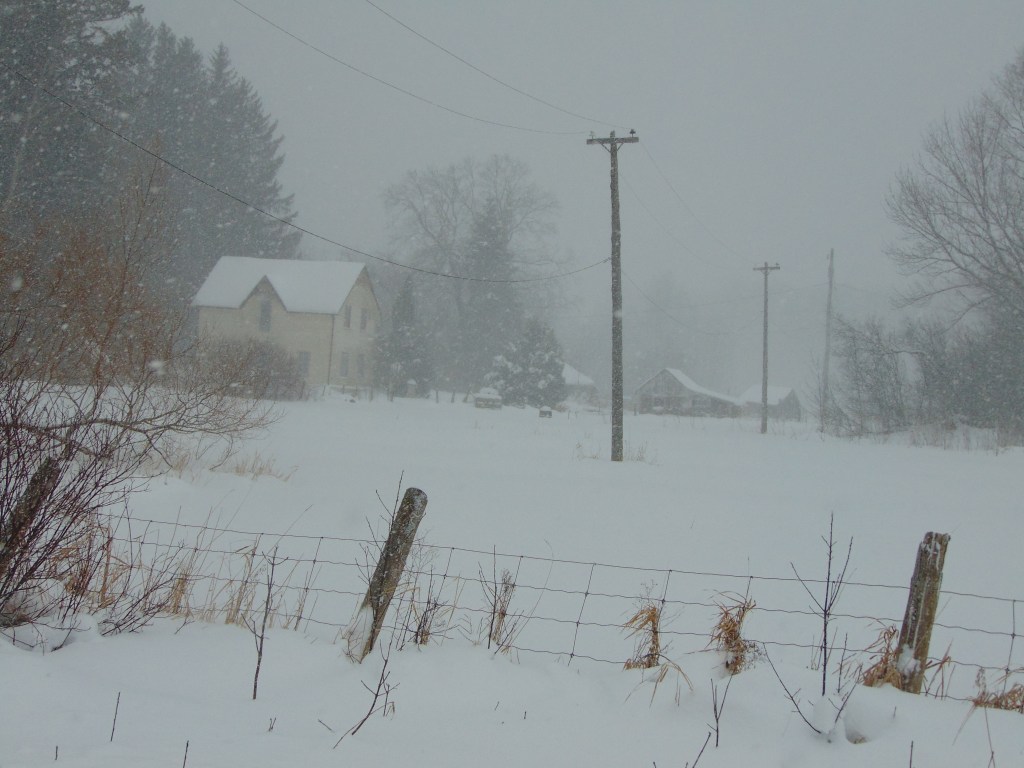
But this is mid-November! Even here in Ontario, Canada 90 centimeters of snow in two days in the fall of the year, and more of the same forecast for the next two days is not normal. Not to mention across the border with the U.S., Buffalo, New York has been buried under twice that much snow. That also is on account of ‘lake effect’ snow squalls forming over Lake Erie, Lake Huron further west, and maybe even Lake Ontario. to the north. Once on their way those squall lines can track across hundreds of miles, or kilometres.
It’s worth noting that up until this past Friday, November broke records in Ontario for summer-like temperatures. Here at the end of Cathedral Drive, on the Bruce/Saugeen Peninsula, near the shores of both Lake Huron and Georgian Bay, the temperature reached the mid-20s Celsius, or mid-70s Farenheit. Two days before the Friday night snow squall hit, I transplanted some Lavender plants. I was worried that was maybe too late, that heavy frost before snowfall might do them in. But now? No problem: the lavender is safe, sound and relatively warm under a thick blanket of snow. The soil might not even freeze if much of that blanket remains, and I think it will. Indications are, including a seasonal, winter forecast I saw months ago, that it’s going to be that kind of winter: long, cold, and snowy. The thick snow blanket will also be good for the garlic I planted a month ago.
Yes, there is a bright side to this unusual weather, extreme, one might even say. I know, tell that to those folks in Buffalo who can’t find their cars because they’ve been buried under 6 ft of snow, So, I hasten to add, I feel your pain, and I sympathize. The last couple of days have been interesting to say the least, here at Cathedral Drive farm. And I can’t wait to find out what the next two days will bring by way of challenges, let alone the rest of winter.
Not to belittle what city folks are going through, especially in Buffalo, but country life has it’s own type of challenges. For example, above all everything depends on being able to get around by car or truck, or horse and wagon, whether it be to the grocery store in a village some 8 kms away, or anywhere. And that, as we all know, that starts with the driveway.
So when I woke up early Friday morning as usual when it was still dark, and let my two dogs out the back door for their morning pee, one look at snow already up to my knees told me whatever I had planned the day before for this new day, was kaput. Even Sophie the Cockapoo, took one look and didn’t want to go out. Buddy my big, beautiful German Shepherd, plunged right in, disappearing into the darkness to check out this sudden, drastic change in the nature of his territory. As for me, I put on my boots, plugged in the long extension cord, and headed for the garage to turn on the tractor’s block heater. On the way I gave myself a pat on the toque for having the presence of mind to connect the snowblower a few days before, despite the warm weather. It had been up by the barn since the last time it was used early last spring. I shuddered at the thought of how hard it would have been to do it under these conditions. The need to get busy and clear the driveway before the snow got much deep deeper was pressing. It’s not a big, two-augured blower; and though it normally does the job, this was not normal and it has its limits.
About an hour later, the tractor/snowblower and I plunged into the snow. Whoops, let’s give that another try with the blower a little higher. That worked, and that became the procedure: a bit at a time, forward and back, up and down, to get the first pass done down the long driveway to the road. Then it was easier, taking the next two passes on either side overlapping with the first.
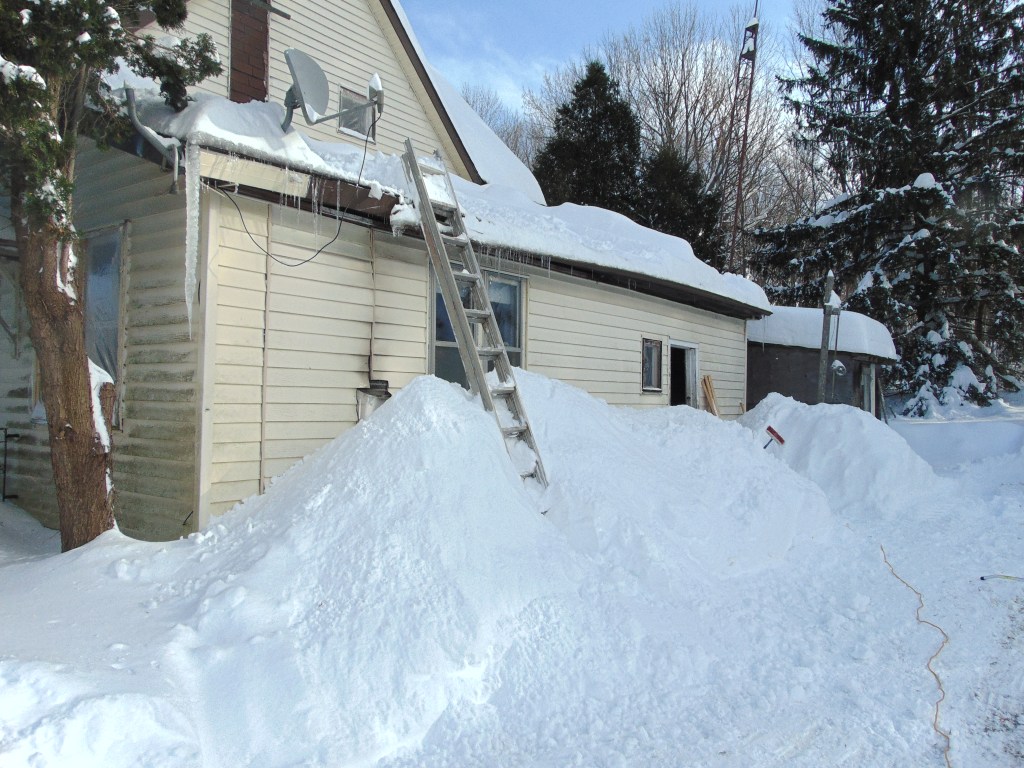
Oh, did I mention I got stuck, that I went a little too far on one side, where there was a slope near a culvert? Well I did, and for a while I thought that might be the end of my snowblowing for the day and perhaps longer. But let’s just say, you find a way, and/or the tractor/snowblowing gods smile, and life goes on. The next urgency was shovelling at least a tonne of snow off a couple of roofs at risk
A few ups and downs continued to happen during this snow squall ‘event,’ and no doubt there will be more. You keep on keeping on. There are neighbors willing to help, and vice versa, if need be. But you know they’ve got their hands full too. Later there were some “are you okay?” calls both ways.
That’s also the way country life goes, and I know for a fact that’s true of city life too. Trust me, there are lots of good people in the world, down the road or the street, or one the other side of the world. That’s one of the things you find out when the weather chips deal you a challenging hand.
A scene from Ballad of a Soldier: a Russian mother waits for her son to come home from war.
I suppose this may not be the best time to say anything good about Russia and the Russian people. But no sooner do I write that than I think, on the contrary, this may be the best time.
The atrocious brutality of one man, and his corrupt enablers, whoever they are, have certainly cast a dark shadow over Russia and its people, who are apparently as gullible and easily manipulated as any nation of human beings on this long-suffering planet. Tragically, that appears to be one of the most fatal flaws of our imperfect species; otherwise, brutal, murderous tyrants, like Vladimir Putin, or would-be tyrants like Donald Trump would be laughed off the stage before they did too much harm.
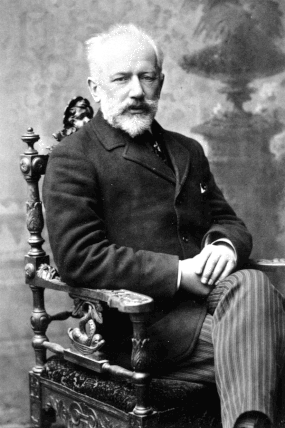
Tchaikovsky
Putin claims to be the Great Defender of everything Russian, including Russian culture. He references the current, conspiratorial ‘cancel culture’ mindset when he says Russian culture is in the process of being ‘cancelled’ by the west, led by the current U.S. administration under President Joe Biden. (No one should underestimate the extent to which Trump’s loss in the 2021 presidential election upset Putin’s grand plan for the takeover of Ukraine, including Trumps likely withdrawal of the U.S. from NATO).
But I dare to say, Russia, Russians, and Russian culture most of all deserves something a whole lot better than Vladimir Putin.
I hasten to say, I am not expert in Russian culture. What I know comes from personal experience and appreciation of the works of certain Russian composers, writers, and filmmakers. I can honestly say, from the heart, that my spiritual life has been enriched immeasurably, and my life changed, since the time I was a teenager by the listening, reading, and watching the great, creative works of the rich Russian culture.
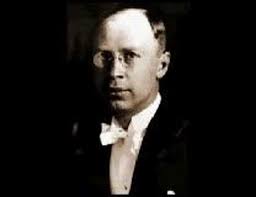
Sergei Prokoviev
I think I was 16 when I first heard Canadian pianist Glenn Gould play Sergei Prokoviev’s 7th Piano Sonata with the dramatic, ‘Precipitato’ final movement, like nothing I’d ever heard before. Thus began my life-long love of Prokoviev’s diverse, creative genius. He stands on a par in my book with Beethoven, possibly even higher; and, with the 9th piano sonata especially, he reached the sublime, ‘edge-of-the-universe’ musical expression of J.S. Bach at his best.
Again, as young man barely out of my teens, I saw my all-time, favorite movie on the unforgettable Elwy Yost’s, Saturday Night at the Movies, on TVO. Despite the less-than-ideal title in translation, the 1959 Russian movie, Ballad of a Soldier, is a classic of world cinema, with the most gorgeous and evocative musical score and wonderful cinematography. The scene at the well in the Russian railyard, when the heroine, holding back her long hair, drinks pure, spring water from a rough iron tap, is a life-lasting image. The hero, the young, Russian soldier, Alyosha, on leave for heroism, finally makes it home to his village with no time to spare. His mother finds out he is home almost too late, runs desperately through the field of grain, reaches the road as the truck carrying her son is driving away, then calls out to him, “Alyosha, Alyosha.” He hears her, but they have so little time to speak. Sixty years later it still brings tears to my eyes.
Scene from Ballad of a Soldier
How many Alyoshas, kept in infernal, misinformed darkness by Putin, died in Ukraine today, I wonder.
Most recently, my new most favorite movie is The Ascent, by Larisa Shepitko, regarded as one of the best women directors in the history of cinema, Shepitko was born in the eastern Ukraine. Her father was Persian. She went to Moscow when she was 16 to study filmmaking and immerse herself in the former Soviet Union’s rich, though tightly controlled, cinematic tradition. For example, Sergei Eisenstein (Battleship Potemkin, 1925, Odessa Steps scene) is regarded as one of the greatest formative directors in film history.
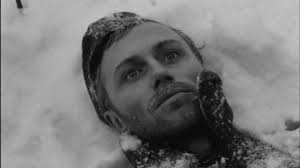
Made in 1977, two years before Shepitko’s tragic death in a car accident, The Ascent follows the fate of two Russian partisan’s as they try to find their way back to their group through the bitter cold of a Russian winter after ambushing a German patrol. They reach a farm where they are given shelter but are discovered and taken to a nearby village. They are sentenced to hang along with a group of villagers. After torture, one of the partisans agrees to work for the Nazis to save his life. The other partisan goes to his death with courage and Christlike faith. It is one of the most deeply moving movie scenes I have ever watched.
A scene from The Ascent
The historic Ukraine-Russia connection, early and late, is complicated, and forged on the crucible of frequent, foreign invaders, notably, Mongols, Napoleon’s Grand Army, and Germany’s Nazi regime. It’s no wonder a good deal of paranoia underlied the empire-building policies of Tarist Russia, the former Soviet Union, and now Putin’s Russia.
Ukrainians suffered greatly during the mid-1930s under Joseph Stalin’s brutal, dictatorial leadership of the Soviet Union. Millions of Ukrainians died of persecution and starvation as a result of famine deliberately engineered by Stalin. Whatever brotherhood may have existed between Russia and Ukraine before then was destroyed by Stalin’s brutality, much like Ukraine is now, again, being destroyed by Putin.
Thus have the evil deeds of two, ruthless dictators led to the current war in Ukraine, and the real possibilty of a global catastrophe. The Ukranian people deserve better. So do the Russian people. And so does the world.
You would think ‘in the best of all possible worlds’ the historic suffering of both the Russian and Ukranian nations would lead them to a mutual understanding of how to live in separate, sympathetic peace.
But this is not the best of all possible worlds, so long as autocratic tyrants are allowed to take and hold absolute, undemocratic power.
Readers of this blog may recall that I have often written proudly about Canada as a wonderful example to a troubled world of a country where a great diversity of people of many cultural backgrounds live together freely in peace.
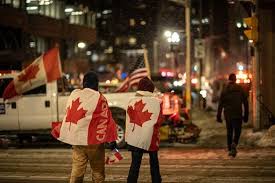
Ottawa in the midst of the Trucker Convoy protest.
I have always in the next stroke of the pen, as it were, noted that Canada is ‘yes, still a work in progress. It has a history of injustices, especially toward Indigenous people, that it seeks in good faith to reconcile. I have always taken a positive attitude, in expressing my personal belief that Canada is ‘heading in the right direction,’ based on the growing mutual respect of Canadians towards each other, and our shared belief, hopefully, that this is a ‘good country.’
That above being said, I now have to say, the events of the last few weeks have been personally disillusioning and heartbreaking.
I must also confess to being … yes, even angered by the sight of large groups of self-righteous people wrapping themselves in Canada’s flag, while doing great harm to the well-being of this ‘good country.’
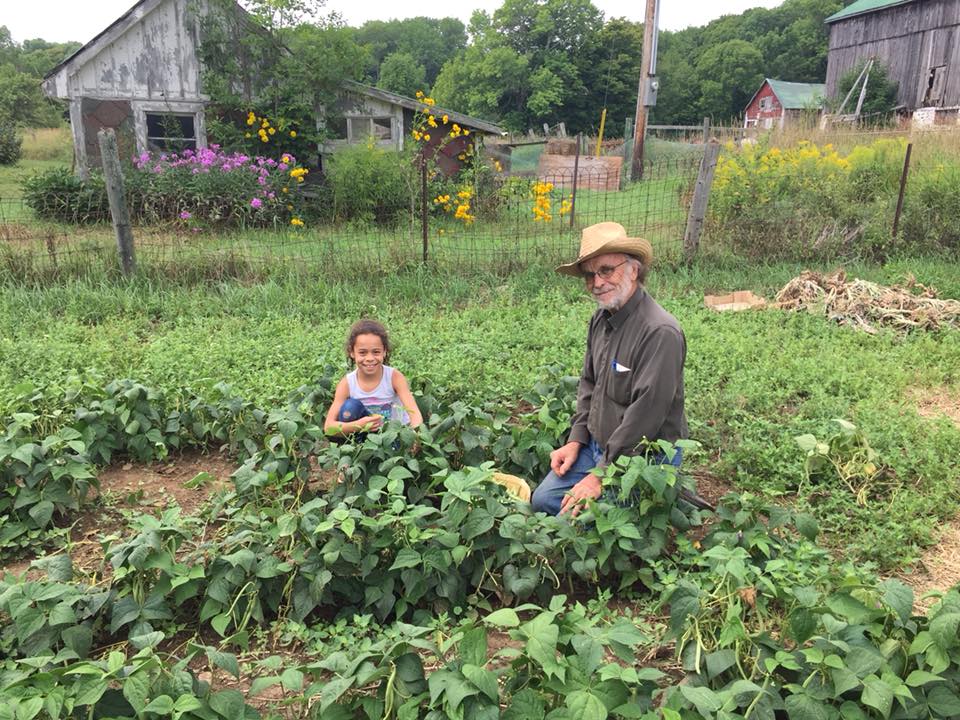
Picking beans with great, granddaughter, Jorden: living the Canadian dream
And for what purpose? The truckers’ protest began with a focus on the federal mandate requiring Canadian truckers crossing the border on their return trip to Canada to be vaccinated against Covid-19 or be quarantined if not. Then it became a protest against all government Covid-19 mandates and restrictions. In the midst of that were growing indications that the real objective is to overthrow the current Liberal federal government and democratic system. And so far, protest organizers – whoever they are, and wherever they are – and defiant supporters still occupying Ottawa and blocking vital, cross-border, trade routes, show no willingness to bend on that extreme demand. Meanwhile, foreign donor money, from ‘anonymous’ sources in the U.S. and elsewhere in the world, has aided and abetted the undemocratic aims; Trump flags and U.S. flags, even Confederate flags, have flown at the Ottawa ‘occupation’ and border blockades. And Fox news, the most politically biased news media venue in the Western world, fans the destructive flames in blatant support. The ignorance of their unqualified hosts knows no bounds.
Meanwhile, around the world, Canada’s reputation as a peace-loving country, and Canadians as a peace-loving people, is in ruins.
I have to ask, who is this benefitting? Certainly, not Canada; and certainly not the future of my children, grandchildren, and great grandchildren; and yours too, my fellow Canadians, who felt warm and secure in the believe our good country was one of the best places in the world to live, and well on its way to being the best. We felt fortunate. We felt blessed. Didn’t we, most of us?
Some among us felt differently. They thought there was something fundamentally wrong, something evil even, embodied in the person of one man, one Canadian, one of us. It is a cruel and dangerous lie.
With certain rare exceptions, who haunt us still, none of us are perfect or evil, trucker convoy protestors and others with different opinions. But the base, human instinct to close doors, to destroy or blockade bridges, to build walls, to fall into tribal traps, to not love your neighbor: those are symptoms of the ongoing human tragedy. As Canadians we are better than that, and as human beings. That sacred truth was reaffirmed, by the way, more than 2,000 years ago. I’ll leave it to the convoy protestors to discern what that comment is about and give it some thought.
Yes, indeed, the snow was coming down heavily when the propane truck showed up early this morning. And none too soon either: the tanks were getting low, and to be on the safe side, I had turned the thermostat down to 60.
So it was, with a certain level of relief I saw the truck coming down Cathedral Drive as I put a blue box full of recyclables at the end of my long driveway, after spending a frigid hour or so blowing it out with the tractor-and-snowblower attachment.
The truck driver was a cheerful young man, talking about the weather, as Canadians are famous world-wide for doing obsessively. (That must be why I’m writing this now, eh?).
He said the last time he had delivered propane to my place earlier, in the late fall, it also had been snowing heavy on Cathedral Drive. “A winter wonderland, eh,” he said cheerfully as he started to pull the long, black hose around to the side of the house where the propane tanks are located. Inside, the dogs were barking excitedly as they always do when the propane truck arrives, or for that matter, anybody or anything.
I decided to keep the tractor block-heater plugged in because, the way the snow was coming down, I’d likely have to blow the driveway again. That’s one of the essentials of getting through a Canadian winter: you have to keep on top of it, whether it be clearing the driveway, shoveling snow off the roof, or making sure the tractor essentials have been looked after: motor oil, antifreeze, gear and hydraulic fluid, battery charging okay, and especially, the block heater working well. Any one of those things neglected, and many others not mentioned, and winter will make you pay the price.
The other thing about winter is it demands you re-arrange your priorities, like, in my case, keeping up on the news is relegated to second place.
Still, I find it hard to imagine how people can live without up-to-date news about what’s going on in the world, especially if it’s something that has the clear risk of being able to create catastrophic chaos. And when I say that I immediately think of the world my three grown daughters, and my many grandchildren may inherit.
In the almost four-score years I have been on this planet, I have never seen such troubling times. At the top of the list of those worrisome troubles is the ongoing crisis south of the border. Make no mistake, the future of Canada, as well as the rest of the world, and the U.S. itself, hangs in the balance depending on what happens there. This new year, 2022, will see it go one way or the other: the survival of American democracy, or a virtual authoritarian regime, even an actual civil war. There’s a virtual one already.
Meanwhile, the Covid pandemic has come back with a vengeance because of the omicron variant, after seeming to be on the wane last summer. It threatens to aggravate the socio-political problems in the U.S. Inevitably, the administration of President Joe Biden, already showing signs of strain, will be blamed if the situation doesn’t change for the better. Talk about a ‘perfect storm.’
And if 2021 didn’t provide enough evidence that climate change is real and closing in on catastrophic consequences – think 50-degree summer temperatures, and -50 winter temperatures in western Canada, for just one example – then I don’t know what more evidence will.
What is the matter with us, we human beings? As Shakespeare had the character, Puck, say in A Midsummer Night’s Dream, “What fools these mortals be.”
All that being said – and much left unsaid – I am compelled to dig down deep and come up with hope, that most positive quality of human nature:
We have it in our power, in the ‘better angels’ of who we are, to change things for the much better. Once our most prehistoric, human ancestors, facing a life-threatening, environmental catastrophe, got together and went in search of a way, and a place to survive and go on living. It was a long and hard journey. It took many years, perhaps many generations. Everyone had a role to play, everyone worked together. They learned out of existential necessity how to be a supportive, peaceful community; otherwise, they would not have survived. Sometimes they laughed, often they cried; they learned how to sing and dance to help keep up their spirits; they created and made tools; they fought off predators by outsmarting them. And they no doubt also prayed to the Great Mystery for strength, inspiration, and guidance.
And they succeeded. And so have human beings succeeded many times in accomplishing all manner of great, good things. That’s who we are at our best: intelligent, individually and collectively, and multi-talented, problem solvers.
I was going to say ‘commodity.’ But that primarily refers to a raw material or agricultural product that is ‘bought and sold.’ It has also come to be applied in a more general sense, as in, “Water is the most precious commodity.”
That’s certainly true enough, including spiritually; but then I would add calling water a commodity doesn’t do it justice. Likewise, Hope, perhaps to an even greater extent.
So, what should we call Hope? Preferably, not ‘it.’ The great Jewish philosopher Martin Buber, best known for his book, I and Thou, would suggest ‘Thou.” The title denotes the different quality of relationship people may have with other beings, ultimately leading to relationship with God, the Creator, the Great Mystery. I use that word, ‘beings,’ in the broadest spiritual sense, as applied to all the natural wonders of our world, and beyond.
Whatever we may call Hope, it is most essential. We cannot live without Hope. Surely that’s true — who can deny? — problems of varying degrees of troubling impact are bound to happen in our lives. It can be, it often is, a hard and frightening world for most of us who simply want to live our lives as best we can with a sufficient level of peace, security and stability, and hope for the future.
But Hope is strained under the weight of too much heartbreak and adversity, and of fears engendered by an overwhelming series of major troubles in the world around us, far and wide. Despair can set in if that persists day after day, month after month, year after year.
Despair is a terrible thing. Taken to heart internally, it will break the spirit, leading to other terrible personal and and community consequences like poverty, homelessness, drug addiction that further eat away at the possibility of renewed hope. It is a foolish society indeed that fails to recognize the need to reach out to help those in such critical need.
Despair also expresses itself outwardly, in confused anger and violence. Millions of people in unknowing despair are easily exploited by selfish, unprincipled people for their own gain, including the pursuit of personal power.
Such, I fear, is the world we now live in; and I confess, I am losing hope.
The Covid pandemic is heading toward the beginning of its third year, with a fourth surge fueled by a new variant that appears to be more infectious, spreading quickly around the world. The Omicron variant originated in southern Africa where, like other poor areas of the world, vaccination levels remain extremely low, compared to richer countries, where booster shots are being pushed to meet the challenge amid indications vaccines are less effective against the new variant. It is hoped booster shots will help.
Meanwhile, the other big story is the continuing crisis in the U.S. Make no mistake, that is an existential, world-changing story that affects us all. I have sensed for some time people are tired of hearing about it. But bury your head at your peril.
In recent days, much new evidence has surfaced about the extent to which the January 6, 2021 attack on the U.S. Congress was the result of a coup conspiracy orchestrated from the White House after former President Donald Trump lost the 2020 election. He continues to claim election fraud, and insists he has the best interests of his country at heart.
The White House
Many observers are publicly wondering why, with more than enough evidence, the U.S. Department of Justice appears to be so passive about laying charges, or otherwise showing its hand. To some extent that is the nature of the beast when it comes to enforcing the rule of law; you take the time you need to do your due diligence to ensure you have a strong case. In this case that is even more important. If charges are laid, especially against Trump, and there appears to be anything less than an ironclad case, there is a real chance of civil war breaking out.
Meanwhile, Republicans control a majority of the state legislatures, many of which are busily passing new laws giving them more power to declare the results of the 2022 mid-term elections in their states, if the outcome is not to their liking.
So, in effect, the coup is still underway. And time is running out.
I don’t know how you feel about that. But I am worried.
The decline and fall of American democracy, and therefore, America itself, will shake the stability of the world to its core. Russian troops are massing on the Ukraine border, because Russian leader Valdimir Putin is, at the least, testing the resolve of the U.S. to do anything.
U.S. President Joe Biden and allies have warned of “consequences” if Russian invades the Ukraine. They would likely be more economic sanctions.
The possibility of war is hanging in the balance. It must be noted that any war between Russia and its allies, and the U.S. and it’s allies, would be fought to a large extent in cyberspace, where Russian operatives have already had much experience attacking the U.S., by interfering in the 2016 presidential election in support of Trump.
Am I getting carried away? I actually hope so. But if the last few years have told us anything, it’s that anything is possible.
In the meantime, I keep my hopes up as best I can by, first, going for morning and evening walks with the dogs.
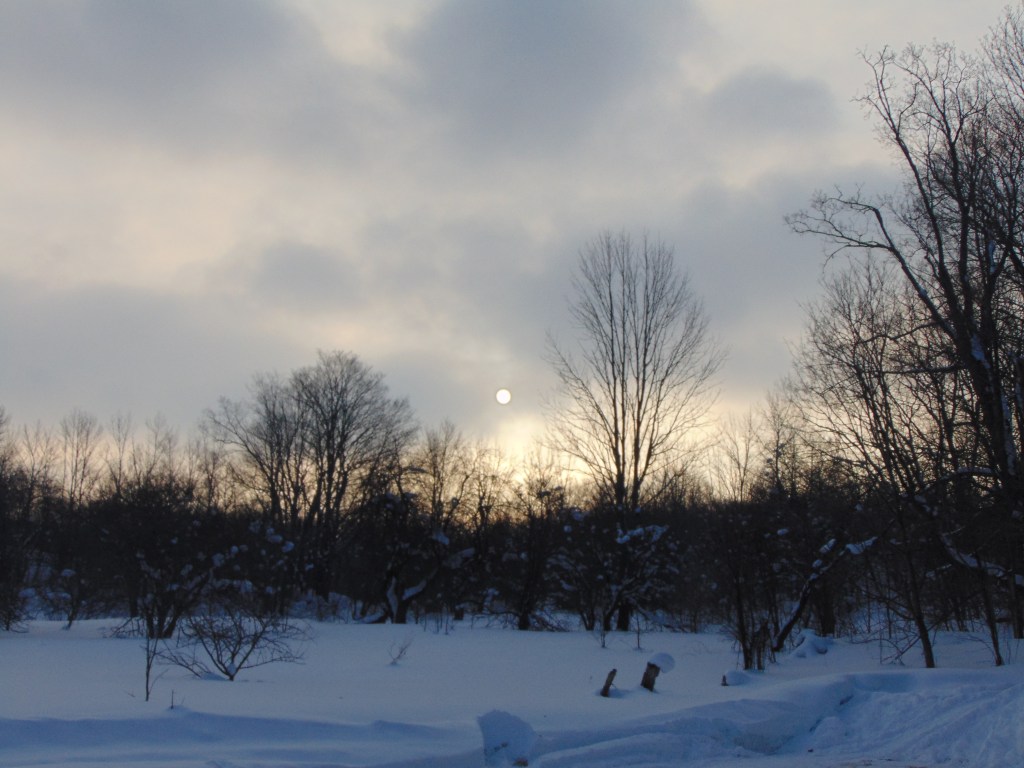
This morning the sun rising through a line of trees to the southeast was enough to stop me for a while. Then on the way back I was struck by how much in a few minutes the sun had risen over the trees.
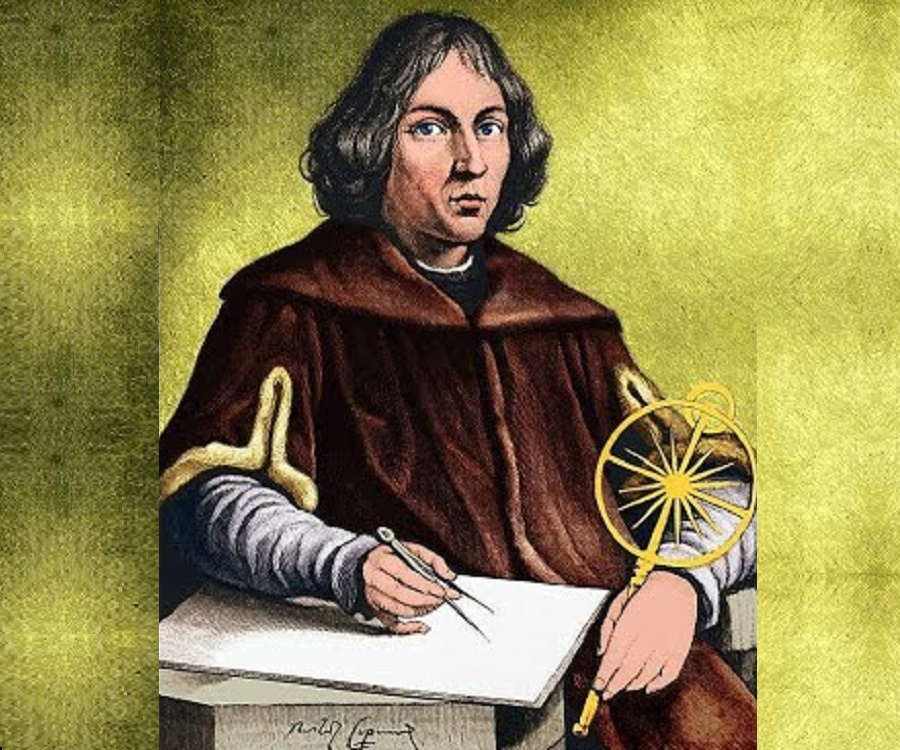
And that led me to think about how for ages people believed the apparent movement of the sun meant the Earth didn’t move, and therefore must be the center of the universe. In the 16th Century a pretty smart guy named Nicolaus Copernicus, a Polish mathematician, astrologist and man of many talents, wrote a book that proved otherwise. It was titled, De revolutionibus orbium coelestium (On the Revolutions of the Celestial Spheres). A Roman Catholic canon himself, he was praised by other learned people, but also strongly criticized by protestant and Catholic church leaders alike for many years.
Nicolaus Copernicus, who put the sun back in it’s right place
Copernicus, being human, worried that might happen, and delayed publication of his book, until shortly before he died in 1543. But even so, he was hopeful: he believed the truth did not diminish, but rather glorified the wonder of Creation; and the day would come when others would see that.
So, thinking about Copernicus raised my hopeful spirits. And then later in the day, I baked bread, and that always helps.
“To know the mighty works of God, all this must be a pleasing and acceptable mode of worship to the Most High.”– Nicolaus Copernicus.









 Finding Hope Ness