The year was 1938. The Great Depression of the 1930s was still underway. Jobs were hard to find and poverty rampant. A job that paid less than $5 a week was about the best a 17-year-old high school graduate could get. So Mom got a job in a paper bag factory. Dad, who was 16, was already working there to help his even more impoverished family survive. He had one shirt to his name, sewn together out of sugar sacks by his mother. It got caught in his machine and torn so badly one day he had to go run home so his mother could quickly sew it back together. Then he hurried back to work to avoid having his pay docked as little as possible. Continue reading
National strategy needed to curb gun violence
The spectre of gun violence and the proliferation of guns in the midst of the so-called “gun culture” haunts the world as never before as we begin a New Year.
What gun-related tragedies will 2015 bring, in what parts of North America and the rest of the world, we can only imagine.
Critics of the now-defunct Long Gun Registry, repealed by Canada’s current Conservative government in 2012, were fond of saying the registry did nothing to keep guns out of the hands of criminals, that it just made criminals out of “law-abiding” citizens who were required by the law to register their long guns.
What nonsense. Justin Bourque, who murdered three RCMP officers last June in Moncton, tried to murder two others, and cried out for more to murder on his rampage, did not have a criminal record before he pleaded guilty to those crimes in October and was subsequently sentenced to 99 years in jail.
His own Defence lawyer, David Lutz, described the high-powered, semi-automatic, M305 .308 rifle Bourque as a “gun that did not belong in Canada.
“This is a gun that went to Vietnam. This was a gun that was used by snipers. People in Canada don’t need these kind of guns.”
Guns are already so plentiful, so much a part of the world in which we live, they’re not hard for people with criminal records to obtain. That apparently was true of the gun used to kill nine people in the Edmonton area earlier this week, a “mass murder” that has shocked that city and the rest of this country and made headlines around the world. So much for Canada’s declining global reputation as a peaceful, non-violent country. The nine-millimeter handgun had been registered in B.C. But it was reported stolen in 2006. There is still much to learn about the circumstances involved, and especially the state of mind of the alleged shooter, except that he may have been depressed and suicidal, and that he had a lengthy criminal record.
The news media had to go to court to get more evidence from the Justin Bourque murder trial made public. That’s a good thing. Canadian society needs to know as much as it possibly can to understand what’s going on, why these terrible things are happening in our midst. We seemed suddenly faced with an epidemic of murderous gun violence in 2014.
Moncton, Edmonton, The National War Memorial in Ottawa, where Cpl. Nathan Cirillo was gunned down, shot in the back by a madman who would have killed many more people minutes later in Parliament if he hadn`t been stopped – these places are all part of our Canadian community.
It could happen anywhere, and it has. A few years ago a family physician practicing medicine in Lion’s Head was gunned down on a country road just around the corner from where I live as he drove home from work.
Somehow, if at all possible, we have to figure out how to see the warning signs before such tragedies happen. We now know Justin Bourque virtually made no secret of his murderous intentions on his Facebook pages, of all places.
We need a national strategy for, not just gun control, but for the control of gun-violence, based on an understanding that digs deep into all aspects of the “gun culture” and why it has so much appeal to people like him.
In the meantime, can we afford to make it easier, not harder, to obtain and own guns? Do we want to become more like the U.S., where the “gun culture” is so deeply embedded, taken so casually, that a young mother carried a loaded handgun in her purse as she shopped with her two-year-old son and several other children in a Wal-Mart store in Idaho? The little boy put his hands in his mother’s purse, got his hands on the gun, and it went off, killing his mother.
It’s a horrible tragedy for that family, one that little boy will have to somehow carry with him for the rest of his life, if he can.
Hayden, the small city in northern Idaho where it happened, is not very far from the Canadian border.
Permits for the carrying of concealed weapons are much easier to obtain in many states in the U.S., including Idaho, compared with Canada. Ironically Hayden just a week earlier had amended its gun law to bring it into clear conformity with the state law allowing gun owners to fire their guns in defence of person or property.
“It’s pretty common around here – a lot of people carry loaded guns,” a spokesperson for the Kootenai County Sheriff”s Office, told the New York Times.
“Guns are part of the Culture,” said Hayden City Administrator, Stefan T. Chatwin.
Years ago I made the point that a citizenry that included people skilled in the use of firearms is a good thing to have, especially in time of war. It helped Canada help win two world wars, including the defeat of a ruthless, murderous dictator.
But do we want a something called a “gun culture” to grow and thrive in Canada. I don`t think so.
Originally published in The Sun Times in January, 2015.
Harper’s meeting with Wynne: not such a good idea after all
(Phil here, having another look at this column dating back to January, 2015 before posting it on Finding Hope Ness. I guess it wasn’t such a “masterful stroke of political choreography” after all. Premier Wynne actively supported Liberal Party of Canada leader Justin Trudeau in the long election campaign that began in August and ended Oct. 19 with the Liberal majority-government victory. There were lots of reasons. But something must have happened here that bothered the Ontario Premier big-time. Or maybe it was just that Harper’s body language, as I suggested, was too obvious. After all it’s possible, I think, that the biggest factor in his election defeat was people were starting to question what was behind the mask. That and the NDP leaving an opening in their platform big enough to drive a Liberal truck through.)
The body language said it all:
The Prime Minister of Canada, and the Premier of Ontario, the country’s most populous and, shall we say, most vote-rich province in the country in this election year had just finished their first face-to-face meeting in more than a year.
Prime Minister Stephen Harper had apparently been giving Premier Kathleen Wynne the cold shoulder ever since she said afterwards he “kind of smirked” when at their first meeting she talked about the need for Canada Pension Plan improvements. That quickly got a bad reaction and a denial from the Prime Minister’s Office.
Harper smirk? Certainly not. Continue reading
As 2014 ended challenges lay ahead
I’ll try not to be too negative. After all, after a year like that, the world needs all the good vibes it can get.
2014 will be mercifully over in a few days. But not the terrible state of human affairs it exposed for the whole, wired world to see in all its tragic brutality.
I think it’s fair to say this is indeed the season, give or take a few days, most people of truly good will, conscience, and intention celebrate the opportunity to do the best they can to live better lives and help make the world a better place.
Bucket challenge good for ALS awareness
I’m technically challenged. I don’t tweet on twitter. I also don’t upload personal videos onto YouTube though we often joke about the humorous opportunities to “go viral” that have been missed in recent years. The talking dogs, for example.
So, it’s unlikely I’ll ever take the Ice Bucket Challenge and join the multi-millions of people doing it, or not doing it, to raise money for amyotrophic lateral sclerosis (ALS) research.
How the Challenge works is a bit confusing. After all, the phenomenon just sort of took off on social media earlier this summer without any clear organizational structure. An article about it on Wikipedia, the on-line encyclopedia, says the “rules” are that anyone challenged to pour a bucket of ice water poured over their head has the option to decline and donate $100 to charitable organizations funding research to learn more about the fatal, degenerative, neurological disorder; or they can accept the challenge, have themselves videotaped doing it, and donate $10. But most people are donating $100 or more regardless.
Tim Hortons does the right thing
The raisin bran muffin is back. Now, I don’t know if it’s a Canada-wide or perhaps even global thing; all I know is I can again get my favourite muffin, the most Canadian one, the immortal raisin bran, at my local Tim Hortons franchise.
So, no more humming and hawing at the order thingy in the drive-thru, no more holding up the line-up of cars and trucks while I try to make up my mind; things are moving along tickety-boo now ‘cause all I have to say is “I’ll have a raisin bran muffin, and a medium coffee with milk.”
And I say that with a certain bravado since I hold myself personally responsible for the change of heart, the coming to their senses in the highest levels of Tim Hortons’ management, all the way to Brazil.
It’s been more than a year since I wrote that column, but it must have had the desired effect. I’ll try not to gloat, but I think I’ll celebrate by giving it an encore, as first published in The Sun Times in August, 2014: Continue reading
An Aboriginal fisherman leaves food for thought
A few weeks ago a well-used pick-up truck pulled into our driveway on the Bruce Peninsula. A man who looked like he might be in his mid-30s got out and said he and his fisherman partner had some freshly caught Georgian Bay fish for sale and did I want some.
They were from nearby Cape Croker, home of the Chippewas of Nawash First Nation, and they were doing what people from there have been doing for hundreds, perhaps thousands of years, trading and bartering the fish they catch, in this case nowadays, for cash. That traditional and vital use of the fishery around what used to be called the Saugeen Peninsula, for food and trade, was recognized and re-affirmed by an Ontario court decision in 1993, that ruled First Nation people in this area were entitled to “priority” use of the fishery in local waters.
At the time most large-scale commercial fishers in Lake Huron and Georgian Bay waters in this area were non-Aboriginal. That court decision began a process of change, leading to the predominantly First Nation fishery that exists today. But the initial reaction of many people in the local non-Aboriginal community was angry and confrontational.
For a while downtown Owen Sound was not a friendly or even safe place for First Nation people to be. One night two young men from Cape Croker were attacked with knives by a group of thugs and badly injured. Continue reading
First Nation land claims will have huge impact
I suppose the day will come that I will have to hang up my journalistic spurs for good, in which case I hope I’m around long enough to see some long-standing big stories finally played out one way or another, for the better.
But in the meantime I attended the public meeting earlier this week about the proposed settlement agreement in connection with the Saugeen First Nation’s lawsuit/claim to much of the rest of Sauble Beach.
I was not the least bit surprised to see the parking lot full to overflowing when I arrived. With the Sauble Beach Community Centre at its 500-person capacity limit, and people being turned away shortly before the meeting began, I was lucky, and much relieved, to get in.
I had gone as much to be a witness to history, as for the sake of immersing myself in the big story yet again. And make no mistake, based on my more than 30 years experience, this is right up there with the Niagara Escarpment Plan controversy in the late 1970s, the Bruce Peninsula National Park debate in the early 1980s, and the terrible reaction in the non-Aboriginal community to the 1993 court decision that affirmed the local Aboriginal “priority” right to the fishery in area waters.
And this, a claim and proposed settlement affecting the Grey-Bruce area’s major summer beach/tourism resource, may be something like a dress rehearsal for an even bigger story to come. That’s the Saugeen Ojibway lawsuit involving road allowances and other land on the entire Bruce Peninsula. Continue reading
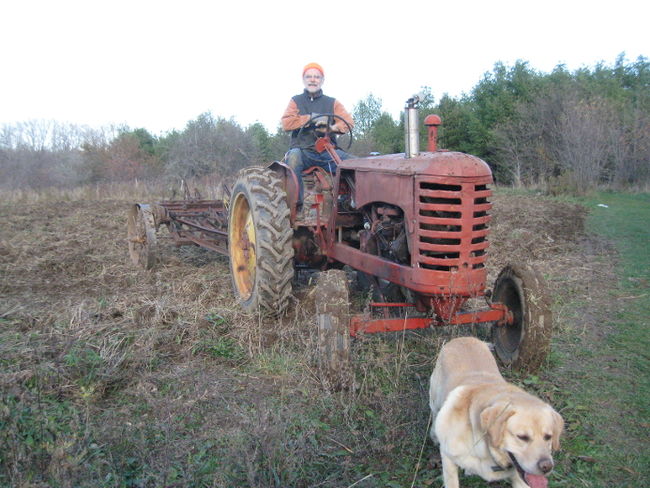
I still love you Mr. Massey
Dear Mr. Massey,
I’m feeling very apologetic. I mean, after all, this is “a fine kettle of fish” I’ve gotten us in isn’t it, as Mr. Hardy would say to Mr. Laurel if memory serves me right.
(Folks of a certain generation would know, while others, I’ve come to realize more and more in recent years, wouldn’t have a clue. Some have never even heard of Bob Dylan, if you can believe.)
Anyway, sad as that is, sadder still is the fate I’ve apparently left you to in your dotage. There you sit still, outside a tumble-down garage full of way too much stuff of dubious value. Oh, there are some hidden treasures in there no doubt, a few homestead artifacts we were anxious to keep under cover among the other detritus of lives past and present that needs to be sorted out and kept, or not. But there never seemed to be time as winter approached and other things took precedence. Continue reading
The special bond between man and tractor
As anyone with the most fundamental experience with wood stoves and rural living will know, if you’re just starting to cut your winter’s supply of wood in early to mid-October, you’ve got a big problem.
I imagine that’s just the sort of thing that spelled potential disaster for many a neophyte pioneer family many years ago. Nowadays there are all sorts of options and/or social safety nets for people who’ve foolishly, or for one reason or another, otherwise failed to get their winter fuel supply set aside well ahead of the onset of winter winds. But back in pioneer days, unless the unseasoned pioneer newcomers were fortunate enough to have a few more seasoned newcomers nearby and ready, willing and able to help, the family risked freezing to death.
 Finding Hope Ness