
The morning sunrise was shining bright as my dogs and I took our morning walk down Cathedral Drive to the broken remains of my touchstone beside the roadway, at the edge of the woods. I noted again how much of the multi-million-year old igneous rock must have been buried there for thousands years after being left behind by the melting glaciers of the last ice age.
But this morning, with the somewhat delayed spring of 2024 finally taking hold, something else caught my eye: leaves of a vine-like plant growing out of what was left of the moss that had covered the above-ground rock. And then nearby, the prolific spring flower I identify as ‘Dutchmen’s breeches’ gathering around the broken rock. And no sooner did I look, then a small gust of gentle morning wind caught a clump of them as if to draw my attention. I know, I know, that may simply be my fancy – but nevertheless, that’s what it seemed.

And, yes, I may be carried away in calling what I saw “small miracles.” After all a miracle, some might critically say, should be of much greater import: the Creator’s hand reaching down to save one life or many from death, or relief from their suffering.
After all, isn’t that what life can do? Not give up easily, but persist, stubbornly to go on living, to find way in the most unlikely places to create new life.
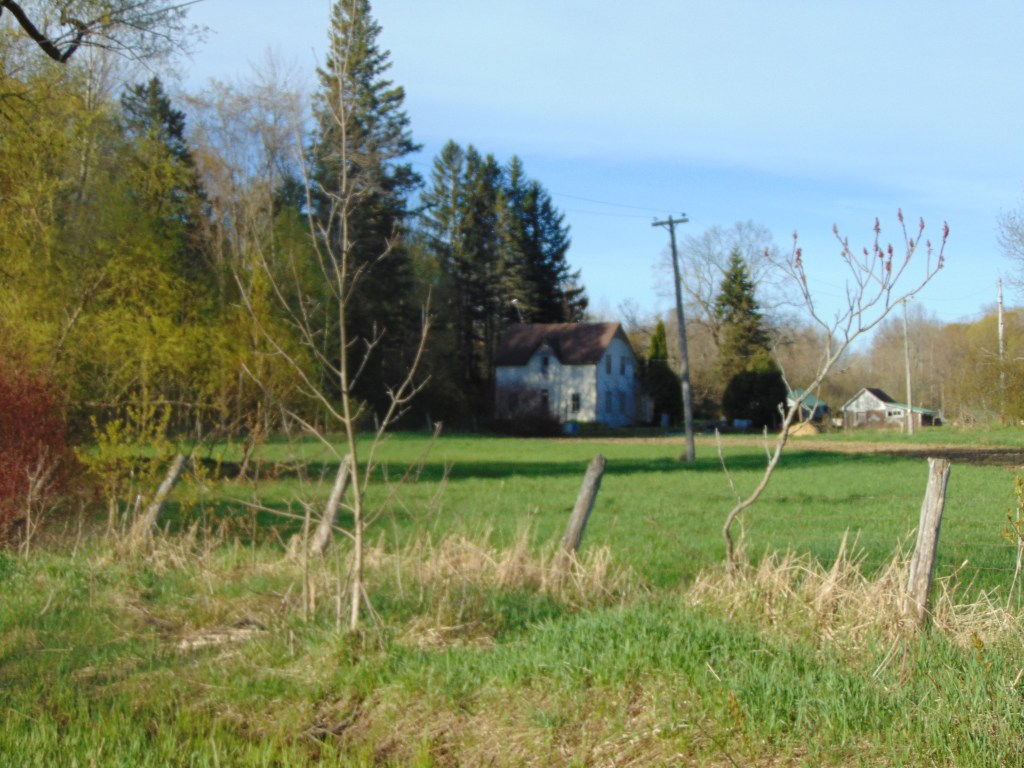
There is a limit though: thousands of species are being lost, vast natural environments destroyed in the name of economic progress and production, and life-unfriendly poisonous paradigms regarded as stubbornly essential, as if life can survive anything. It cannot, not even in a relatively small, designated government nature reserve that happens to surround my little farm; and an old tractor that probably should be in a museum.
So, yes, surely it is well worth taking a moment to draw attention to life’s ‘small miracles’ in the midst of such an age, while we can.
 Finding Hope Ness