The morning sunrise was shining bright as my dogs and I took our morning walk down Cathedral Drive to the broken remains of my touchstone beside the roadway, at the edge of the woods. I noted again how much of the multi-million-year old igneous rock must have been buried there for thousands years after being left behind by the melting glaciers of the last ice age.
But this morning, with the somewhat delayed spring of 2024 finally taking hold, something else caught my eye: leaves of a vine-like plant growing out of what was left of the moss that had covered the above-ground rock. And then nearby, the prolific spring flower I identify as ‘Dutchmen’s breeches’ gathering around the broken rock. And no sooner did I look, then a small gust of gentle morning wind caught a clump of them as if to draw my attention. I know, I know, that may simply be my fancy – but nevertheless, that’s what it seemed.
And, yes, I may be carried away in calling what I saw “small miracles.” After all a miracle, some might critically say, should be of much greater import: the Creator’s hand reaching down to save one life or many from death, or relief from their suffering.
After all, isn’t that what life can do? Not give up easily, but persist, stubbornly to go on living, to find way in the most unlikely places to create new life.
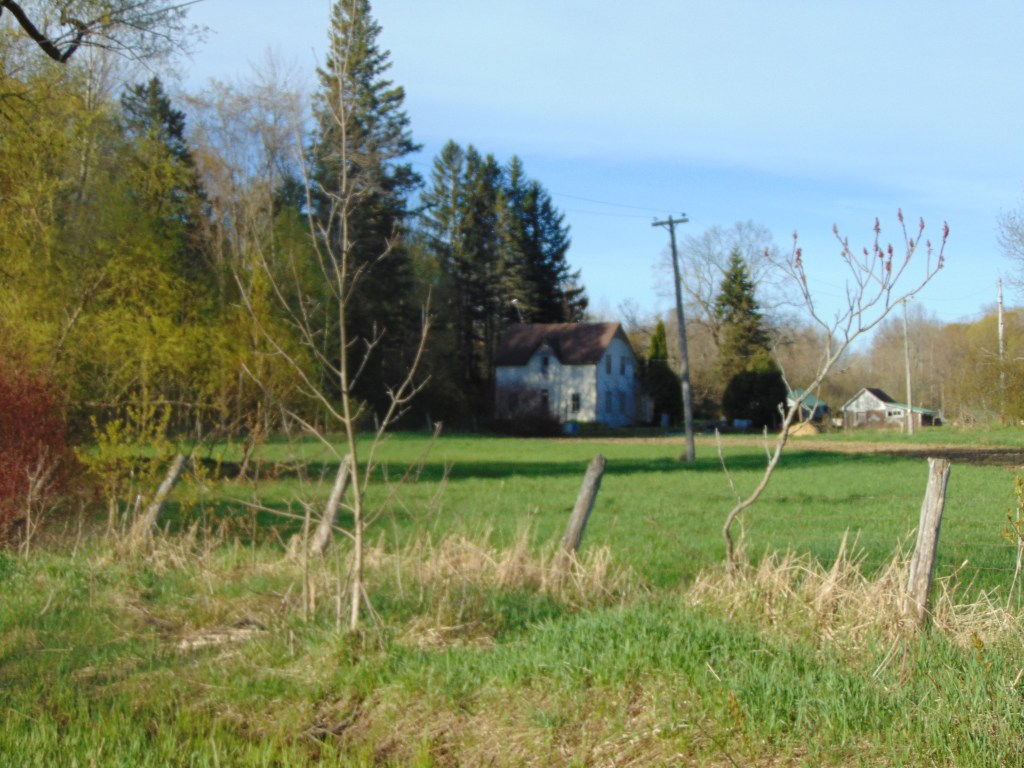
There is a limit though: thousands of species are being lost, vast natural environments destroyed in the name of economic progress and production, and life-unfriendly poisonous paradigms regarded as stubbornly essential, as if life can survive anything. It cannot, not even in a relatively small, designated government nature reserve that happens to surround my little farm; and an old tractor that probably should be in a museum.
So, yes, surely it is well worth taking a moment to draw attention to life’s ‘small miracles’ in the midst of such an age, while we can.
So said my father when he first set eyes on me, just brought home from the hospital, when I happened to open my eyes just as he looked down into the crib. He covered his eyes with an arm and looked away in surprise, and, apparently, shock. That’s the story my mother told me many times when I was a boy. For some reason she never explained, or perhaps knew; in which case she must have felt instinctively it was something I should always remember.
And, so I have, though not precisely this morning when the sun rose in a mostly bright, blue sky. A few clouds were gathering on the horizons over Lake Huron and Georgian Bay. The day stayed cold and bright until late afternoon. But by early evening dark clouds were rising up on the horizons over Lake Huron and Georgian Bay, to the west and east respectively. I fed Buddy and Sophie, and a few minutes later we went for our ‘evening walk’ down Cathedral Drive to the touchstone.
I started thinking about how certain great poems or lines from Shakespearean plays have often come to mind; and not always when I’m in a mood and need that consolation. Sometimes, just the sound of words spoken dramatically, with the wind roaring through the bare branches of late-fall or winter trees — sometimes that’s more than enough reason; and I hold forth with lines like:
“Dark hills in the west, where sunset hovers like a sound of golden horns that sang to rest, old bones of warriors under ground,” the first few lines of The Dark Hills, one of my favourite poems, by the American poet, Edwin Arlington Robinson.
That led me to thinking about my father and how from an early age he loved words and devoured the great works of English literature, especially poetry, Shakespearean plays, and the short stories of Ernest Hemingway, who he regarded as an underrated author.
My father certainly certainly encouraged my own interest. I remembered one time in particular when I was 11 and we were still together as a family. He came into the living room and noticed I was reading a seriously thick, hardcover book. I think I got it from the school library.
“What are reading?” he asked. “Two Years Before the Mast,” I replied. He lit up with keen interest and recognition. He didn’t have to say, he had read it: it was written in his eyes. “A good book for a young man to read,” he said, as he sat down beside me. “You must be enjoying. I see you’re more than halfway through it. Good for you. Quite a story, isn’t it?” It was Richard Henry Dana’s classic, 1840 memoir of his two year journey as a young man from Cambridge, Massachusetts, to the California coast. In those days, long before the Panama Canal was built, it was a long and perilous voyage down the Atlantic Ocean, through the Magellan Strait at the southern tip of South America to the Pacific Ocean, then north to California.
“Oh, yes,” I said, happy and proud to have my father’s approval.
It was about that time, either the Christmas before or after, when he gifted me with a bound copy of Mark Twain’s classic, The Adventures of Huckleberry Finn. Inside, he had written: “Read as a boy, understood as a man.”
My father’s formal education ended when he turned 15 and he went to work to help his poor family survive the Great Depression. At most he got a year or two of High School, at Western Technical School in Toronto.
He was born in 1923, and adopted as a newborn baby within days of his birth. He was just days away from his 20th birthday when he looked down into my crib and said what he said about me apparently having had a previous life. Where did that come from at such a young age, one might ask. He prided himself on being a rational man by then. But already, he had seen enough of life’s pain and heartache to inform his soul. The death of my parents’ first child, a baby-girl named Susan who died at birth, was especially painful. At that hospital, in those days, my mother was not allowed to see the body of her still-born baby. But my father saw her. I don’t know that he was ever the same again, though my much younger sister, who he also named, Susan, and my brother, David, have told me our father found some peace of mind before he died.
He died in Los Angeles, in August, 1970. He was just 47 years old. With his, literally, last breath, he reached out desperately for more. Life had not been kind to him in many ways, with being abandoned at birth his first misfortune. But he loved life with all the passion of his deep, though troubled being.
“For he was likely, had he been put on, to have proved most Royal …,” Shakespeare wrote for Fortinbras to say, after the death of Hamlet. That’s one of those lines I also often call out for someone to hear, somewhere. My father may have had good reason to do the same.
Had he seen those dark clouds gathering across the skies over Cathedral Drive and Hope Ness this evening, and felt the cold, ominous wind blowing out of the Northwest, I have no doubt he would want with all his heart and soul to savour even that precious moment of being alive again.
It’s taken me a long time, way too long, considering how little time we have to live on this precious little jewel of a planet, to fully appreciate the wonder of it all. And by that, I mean everything alive, or seemingly not, like the rock, the moss-covered touchstone, my dogs and I walk to every morning to start the day. What mysteries, what past or even present lives does it hold?
As I reflect on such things, the dogs go about their doggy business of exploring and sniffing every nuance of smell and presence that emerged from the forest during the night to wander across or down the road.
I watch them closely, now more than ever, wondering what interesting stories are being spun and told in their canine minds, and messages going back and forth to each other, as tails wag in excitement and the scent trail carries them along.
I say to Buddy, my big, beautiful German Shepherd, ”whatya got, Buddy? Whatya got?” And he tilts his head the way shepherds do, and lets out a little yelp, as if to say, well, I’ll say it for him, “something really interesting and exciting.”
Sophie, the Cockapoo, pulling hard on the leash, her even more intense sense of smell compelling her to just get on with the exploration. I’ve learned not to let her off-leash; otherwise, if I looked away for too long heaven knows where she might go – off into the woods, up into the barn, somewhere, and me calling over and over, “Sophie, Sophie, Sophie.” She comes in her own good time. I called it mischievous. Sometimes, not being as smart as her, I confess I even called her, “bad girl.” She looks at me as if she’s wondering why I’m not happy to see her. Good point. I am. I just need to get my priorities right, Sophie.
Getting to know both my dogs has been as much a learning experience for me as for them. And how well I do that, I have also learned, makes all the difference in how much we enjoy and appreciate each other.
I had a good teacher. His name was … his name is, Aussie. I can’t bring myself to use the past tense, not yet, or on second thought, not ever. Aussie will always be. There may be dogs that were, and are, as loved and loving. But none more.
I have a friend and neighbor who once told me a few years ago, “dogs are more intelligent than people.”
I think I responded with a somewhat surprised, skeptical look. I may have said, something to the effect that, well, yes, maybe in some intuitive ways.
But I have since come to the conclusion she was right, about the intelligence of dogs in the most important way, a way that, “surpasses all understanding,” words some religious people often use to describe matters of faith.
I’ve had first-hand experience of dogs sensing peoples’ moods, especially when they’re feeling unhappy, and the tears come. I lived on a farm many years ago where two dogs were the best of canine friends. They went everywhere together. The farm was fairly close to a paved road leading to and from Square One, a large suburban mall in Mississauga, near Toronto. One day one of the dogs got hit by a car and was killed. We buried him on a hillside near the house. For weeks, the other dog lay beside his friend’s grave. If anyone said anything to him, to call him over to eat, for example, he would just lie there and look sadly back at us for a moment, and then turn and put his head down again. So we took his food and water over to him.
I was not Aussie’s primary owner when we first met. One day I showed up as a newcomer man-human in the precious place he had shared with Linda since he was a pup. He was about a year-and-half then, an almost full-grown yellow Labrador. I count it as a blessing, that one of the most memorable moments in my life, is when Aussie made me feel welcome. It was as if he already knew me.
It’s true, some dogs, of some breeds, are friendlier than others, and Labs are known to be good-natured. But I say this in all seriousness, dogs have a way of knowing who you are.
Some years later, when circumstances changed, as they often do in human relations, Aussie and I remained good friends, as did we two humans. He always walked over to offer himself up for some petting and a belly-rub. Eventually, I began to call him affectionately, “old man,” as in one old man to another. He was showing his age and getting slower of foot. Not the young fellow anymore who would chase a stick all day if you let him. “Me too, Aussie,” I whispered.
I was glad to be able to help bring him safely home to “the farm” a few days ago.
And now, Aussie, I want to tell you, you are a better ‘man’ that I was in a lot of ways. You taught me a lot about loving, people as well as dogs. And as I write that, and my tears begin again, Buddy gets up from lying a few feet away, to be closer, his eyes knowing.





 Finding Hope Ness