Wonderful surprise ongoing: volunteer squash wanted to live

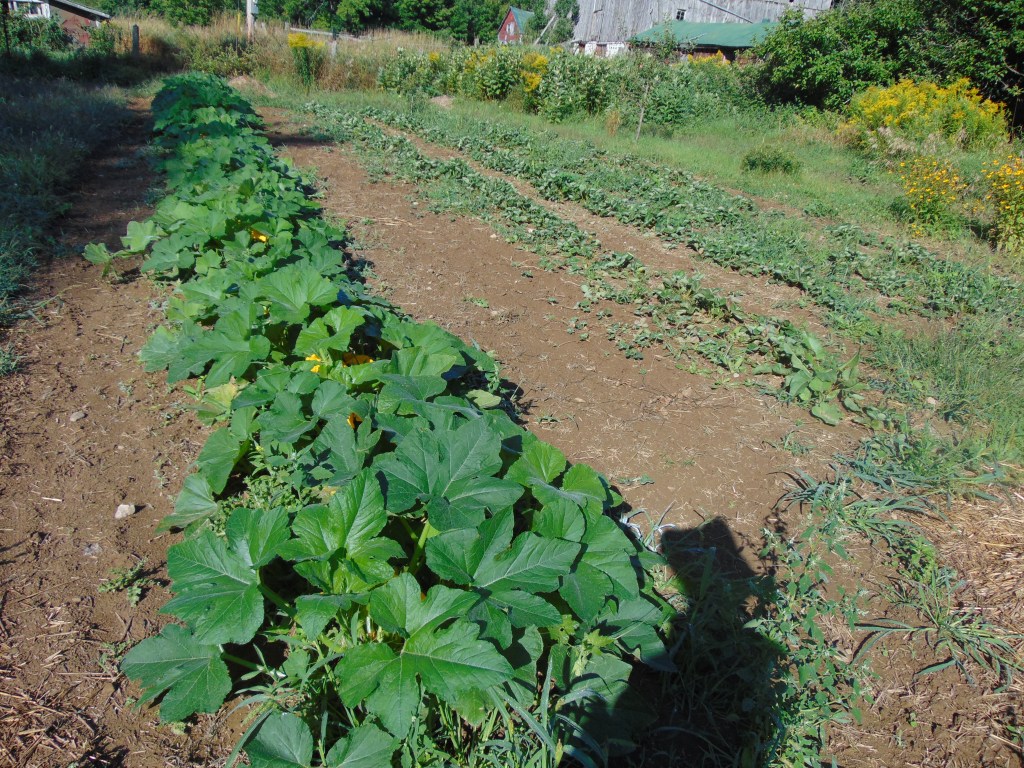
A row of transplanted ‘volunteer’ squash, hoping for a warm September

As many of my millions of readers will know, I live in anticipation of the next wonderful and often surprising moment.

They may not necessarily have global significance, except in so far as in that moment there could also be a meaningful message that might help someone on this still-beautiful, little planet get through their day and find hope for the future. And that is no small thing, after all.

And so, I offer this moment in my garden, leading possibly to yet more wonderful and surprising moments:

It began ordinarily enough: In early July I decided it was time to spread the compost pile that began during and after last years garden season as I worked the garden and to a large extent lived off the produce through the winter. The strawberry patch had finished producing, so I spread what appeared to be well-done compost in between the rows. About a week later I was amazed when I saw that hundreds of squash plants had ‘volunteered’ to germinate.

“Look at us,” I imagine them now crying out to me at the time, “we survived. We didn’t want to go off into the compost realm of being, however interesting it might be. We wanted to live again, as Squash.”

Now, you may wonder at the state of mind that considers such fancies. But in my dotage I have learned to let it “all hang out” finally, to have a little imaginative fun, when there’s no harm done. Call it freedom.

At any event, I let the volunteers grow, but was again amazed to see even more emerge, pushing their way through the crowd until it was obvious they would all soon make a canopy over the overwhelmed strawberry plants. So, I made a choice, first to thin the squash crowd, then transplant the best to a row of their own where I had planned a couple of new rows of strawberries as the runners from the existing rows spread that way. I reasoned that by the time the squash produced a late crop in September, assuming no early frost, that the ground would still be available for strawberries after the squash was harvested.

The other part of that reasoning was complicated by the fact I didn’t really know what to expect, regarding the type of squash the volunteers were likely to be. I had grown a couple of types of squash the previous season, including one I called my “weird” squash because it was derived from seeds I had saved from the 2020 season when I planted two varieties too close together and got a surprise hybrid that turned out to be remarkably colorful, and tasty, but hard to cut open.

So, “to make a long story short” as I say way too often, it remains to be seen what the volunteers will be. So far as I can tell from the fruit just starting to form, it looks like a butternut/acorn combination ‘winter’ squash.

Time will tell.

The original ‘peaches and cream’ sweet corn, non-GMO, Ontario Seed Company, ready to pick at Cathedral Drive Farrm

I find it very interesting to experiment in the garden like that, following an intuition not to get too carried away. There’s more than enough of that going on. Yes, of course, a good deal of selection has taken place over the thousands of years human beings have domesticated and naturally developed plants for consumption. But genetically engineering plants seems to me to be treading where we don’t belong. For example, vast quantities of corn, sweet corn included, have been bio-engineered with bacillus thuringiensis, a natural organism present in soil. In concentrated form it has been used, myself included, for years as an organic pesticide, harmless to humans, to control corn borer and corn earworms. They were not indigenous to North America, but once introduced accidentally years ago, there was always a big risk of a spoiled crop. But now, one of the problems with GMO-BT corn is – because “nature abhors a vacuum” – the sweet corn pests are already becoming immune to BT.

Speaking of squash again, squash bugs are a pest that often attack squash plants. I am very reluctant to use even organic, insecticidal soap to control them, mainly because I often see bumblebees and other pollinators feeding on the pollen of those beautiful, bright orange squash plants. So far this year, there doesn’t appear to be a serious squash bug problem in the several plantings of butternut squash and among the ‘volunteers.’

So, all things considered, I am looking forward to a wonderful squash harvest this fall.

Speaking of the back field and the nature of heritage

More than 40 years have passed since I came here to help the late Wilma Butchart and her son Cliff bring in the hay from that beautiful back field that reached out to the depth of their original 100-acre farm lot, with the mature hardwood forest on either side.

Wilma and Cliff were the first Hope Ness residents we met in June of 1979 when my then wife, Colleen, and I moved up from Toronto to Hope Ness. They welcomed us in the traditional way, with a gift of home-cooked goodness, a generous smile, and kind words. We became friends, and thanks to Wilma and Cliff we learned a lot about the history of Hope Ness, especially the Dow Chemical ‘takeover’ in the mid-1960s. (I have written previously about that in Finding Hope Ness at this link.)

Hope Ness was saved from the terrible fate of being turned into a huge quarry when Dow decided not to go through with its plans, and the Ontario government ended up owning the 2,000 acres (810 hectares) Dow had bought for a measly $5,000 acres per 100-acre farm. Most of the homes and barns had already been demolished, except for the Butchart farm, where Dow had set up its on-site base of operations. Wilma and Cliff continued to live there as tenants when the province took over ownership. Eventually, they managed to get title back to the house, barn other out-buildings, and 5.9 acres. They were also able to continue cutting and taking the hay off the back field to feed their livestock. That permit stopped eight years ago when Cliff passed away. Coincidentally, the province decided about the same time to stop issuing any more such permits on its Hope Ness land. That includes the Hope Bay Nature Reserve which surrounds the former Butchart home and property which I now own, and where I live.

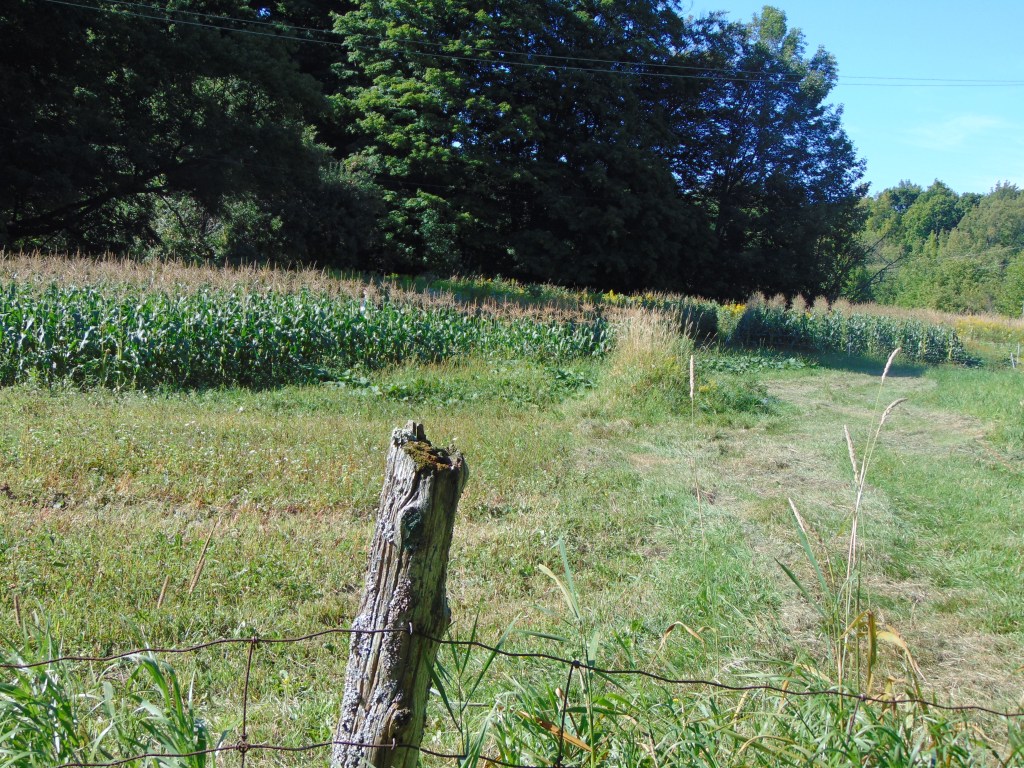
I keep the hay cut on the small part of the back field I own. Beyond that I can see the new tree growth is now well underway. Already, that part where the forests on either side were nearest has begun to close, like a door on the past.

I remember being out there with them, Wilma driving the same Massey-Ferguson 65 tractor I’m still trying my best to keep in good shape, me tossing the bales up onto the hay wagon, and Cliff building the load. And so it went, back and forth to the barn to unload, for several days.

Invariably now, as I stand beside the barn and look out from there over that field as the trees and other seasonal-wetland vegetation take it over again, I also think about the years of back-breaking work that went into clearing that land. And also, the intense work that went into digging wells to help drain it, as often happened in those days. The most remarkable, where the back field begins, is a 20-ft deep well, carefully and expertly walled with stone and cement. That well also served as the main source of water for the house and pasturing livestock. It seems almost unimaginable, and yet I can see it after all in my mind’s eye: the men down below in the darkness, rocks and soil being hauled up by others. By the end of the spring run-off that well is always full to the brim. I use it to water my market garden as needed, which is often, this dry 2022 season especially.

The first house, later used for livestock.

All that work began in Hope Ness after 1880 when the first owner, John Heath, bought the 100-acre lot for “one hundred dollars,” according to the Crown Patent. Other Hope Ness settlers arrived about the same time from down south, or from ‘the old country.’ They had hopes; they had dreams; they worked their hearts out. For some it was too much to bear. Others stayed and survived, with more hard work that we nowadays can hardly fathom. Eventually, by the time the man from Dow showed up that fateful day, there was “a farm on every hundred acres,” as I heard it said in the summer of 1979. And even then, it was still a hard-scrabble, subsistence way of life. So, $5,000 must have seemed like a lot of ‘cash money,’ and maybe a once-in-a-lifetime chance for something better.

I do know that Wilma Butchart (Tucker), born and raised in Hope Ness, never wanted to leave. She loved this land, and the walk through what she called “the Cathedral Woods” to the lookout over Hope Bay, and Georgian Bay beyond. It was her refuge, her special place.

As a child and young woman born and raised on the nearby Tucker homestead, she loved to walk through the woods. She told me of seeing First Nation people from their nearby Nawash community across Hope Bay as they gathered edibles and natural remedies in those same woods. She spoke respectfully of that experience. I’m sure she would have joined them, being who she was. She certainly would not have thought it amiss in any way; on the contrary, she would have welcomed them.

As I look out across that field, I wonder also how much time it takes to have a true heritage, a feeling for a place, the land, the waters, that goes so deep it becomes an essential part of one’s being. Less than 100 years of non-Indigenous settlement had passed since 1880 by the time Dow showed up in the mid-1960s; and little more than 100 years since the Treaty of 1854 that opened the Saugeen Peninsula for settlement was signed under controversial circumstances. The era of settlement is not “since time immemorial,” it is fair enough to say.

And what of me? Am I, who wasn’t even born here, entitled to feel that I truly belong here, this place where I feel so much at home, which I love, as if it was always meant to be? Or is that a foolish thing to say, let alone think under all the circumstances?

I ask these questions sincerely, without any underhand motive. It’s just a question, from my heart to other hearts who know what it means to love their heritage.

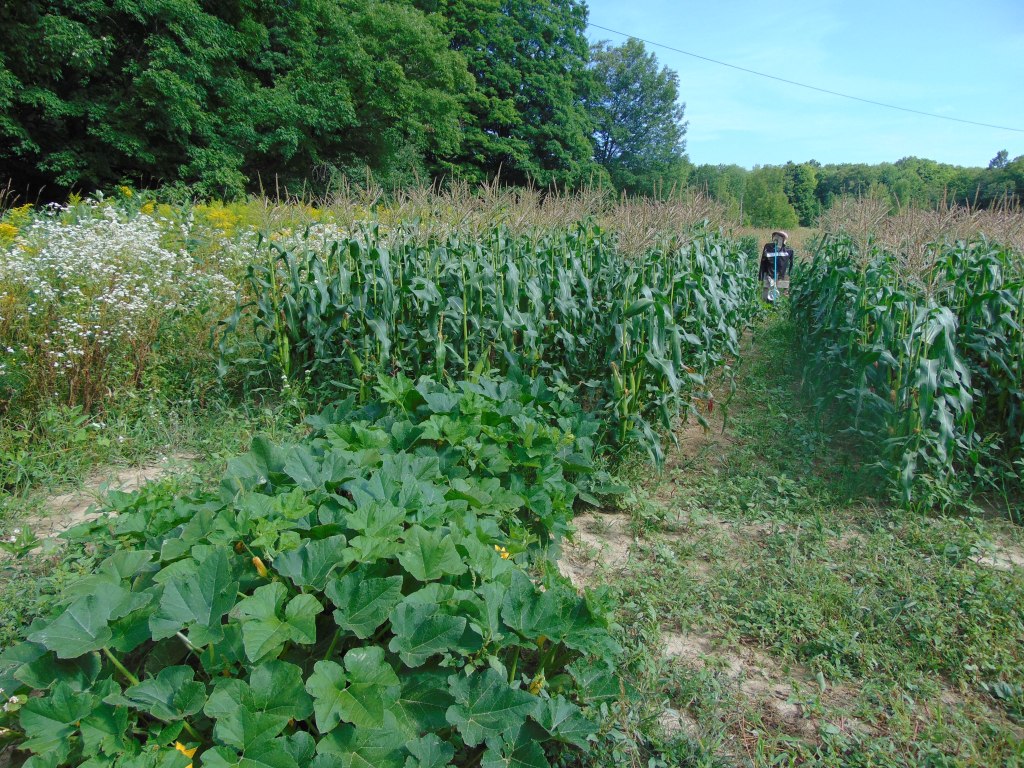
Corn, squash and beans growing in the front field, August, 2022.

On the hopeful resilience of gardening, and Lawrence O’Donnell’s interesting timing

In these most troubling times, with among other things the world’s first and greatest modern democracy in grave peril, I look daily to my garden for relief and consolation, and hope. I trust I’m not alone. Others, I know are doing what they can in their own way to keep their spirits up.

Every annual garden season in this little part of the world has its challenges; and the 2022 season has been no exception: unseasonably cool weather and drought in spring held held back the growth of plants started indoors then transplanted outdoors in late May. Seeds planted were slow to germinate. Many hours spent pumping and hauling water from two dug wells helped keep the garden in survival mode. When the rains finally came, it was never enough. A good soaking rain a week or so ago for a couple of days finally did wonders for the ‘three sisters,’ corn, squash and beans, and the prospect of Roma-type tomatoes for homemade pasta sauce.

But most of all I am again reminded of the determination of plants, and the strength of the life-force to overcome hardships, not the least of which is the heavy, clay-loam soil in these parts. Before the recent rain, when I set about to dig the first row of Yukon gem potatoes, I had trouble getting the digging fork into soil that seemed to have turned into virtual cement. And yet, there they were, good-sized plentiful tubers, showing only slightly the struggle it must have been for them to form. My habit of mulching with a generous depth of straw surely kept some moisture in the ground. But I give the potatoes most of the credit for their fortitude. Then came that soaking rain and the digging became easier.

Before the rain I was wondering how the sweet corn – the original, Ontario Seed Company, ‘peaches and cream’ bicolor – was ever going to fully develop and ripen. But within a few days, the development of the cobs was remarkable. And now I fully expect to have lots of corn ready for harvest by the end of the week, and on into the Labor Day weekend, and beyond, with a good, old fashioned corn roast to celebrate.

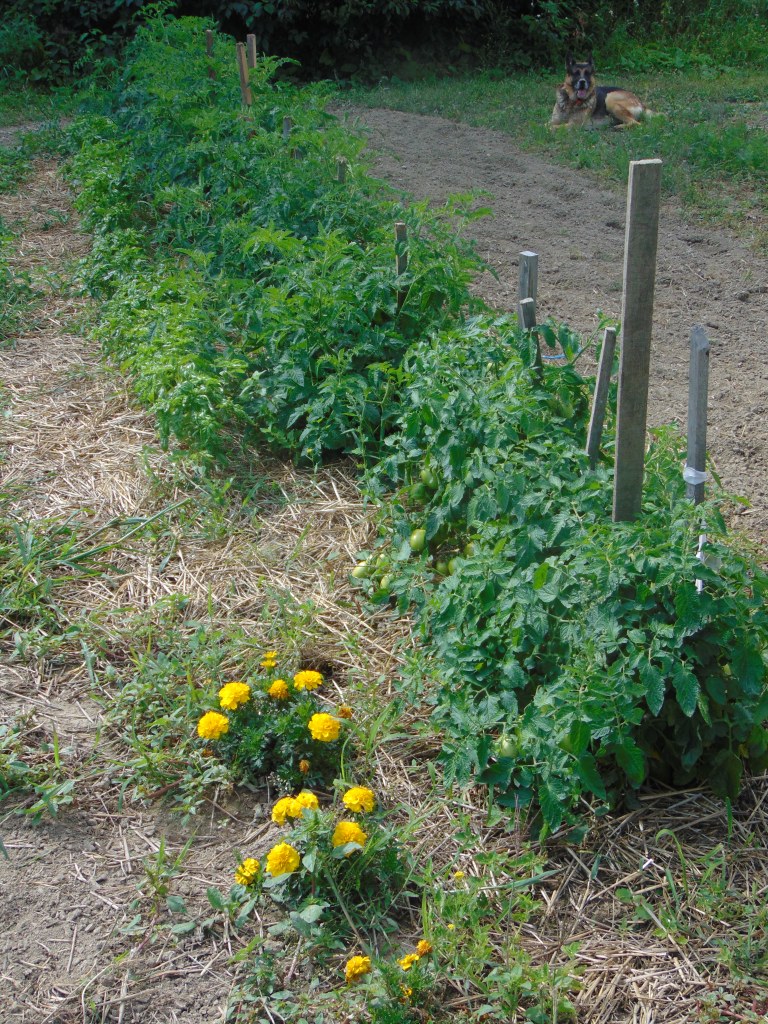
Likewise, the Roma tomatoes looked good alongside a bumper crop of Genovese basil, and another called ‘Sacred.’ That name reached out. I had to have it.

And so I am reminded again that hope, the appreciation of life’s rejuvenating powers, is the spiritual harvest of gardening and life. Good things can still and surely must happen. We must not give up.

By the way, for further context, I submit the following link that appeared on Youtube again a couple of days ago, with interesting timing regarding the recent Search Warrant that retrieved certain documents from Donald Trump’s home in Florida. The question has been asked what he might have done with them, or done already.