Bucket challenge good for ALS awareness

I’m technically challenged. I don’t tweet on twitter. I also don’t upload personal videos onto YouTube though we often joke about the humorous opportunities to “go viral” that have been missed in recent years. The talking dogs, for example.

So, it’s unlikely I’ll ever take the Ice Bucket Challenge and join the multi-millions of people doing it, or not doing it, to raise money for amyotrophic lateral sclerosis (ALS) research.

How the Challenge works is a bit confusing. After all, the phenomenon just sort of took off on social media earlier this summer without any clear organizational structure. An article about it on Wikipedia, the on-line encyclopedia, says the “rules” are that anyone challenged to pour a bucket of ice water poured over their head has the option to decline and donate $100 to charitable organizations funding research to learn more about the fatal, degenerative, neurological disorder; or they can accept the challenge, have themselves videotaped doing it, and donate $10. But most people are donating $100 or more regardless.
Continue reading

Tim Hortons does the right thing

The raisin bran muffin is back. Now, I don’t know if it’s a Canada-wide or perhaps even global thing; all I know is I can again get my favourite muffin, the most Canadian one, the immortal raisin bran, at my local Tim Hortons franchise.

So, no more humming and hawing at the order thingy in the drive-thru, no more holding up the line-up of cars and trucks while I try to make up my mind; things are moving along tickety-boo now ‘cause all I have to say is “I’ll have a raisin bran muffin, and a medium coffee with milk.”

And I say that with a certain bravado since I hold myself personally responsible for the change of heart, the coming to their senses in the highest levels of Tim Hortons’ management, all the way to Brazil.

It’s been more than a year since I wrote that column, but it must have had the desired effect. I’ll try not to gloat, but I think I’ll celebrate by giving it an encore, as first published in The Sun Times in August, 2014: Continue reading

An Aboriginal fisherman leaves food for thought

A few weeks ago a well-used pick-up truck pulled into our driveway on the Bruce Peninsula. A man who looked like he might be in his mid-30s got out and said he and his fisherman partner had some freshly caught Georgian Bay fish for sale and did I want some.

They were from nearby Cape Croker, home of the Chippewas of Nawash First Nation, and they were doing what people from there have been doing for hundreds, perhaps thousands of years, trading and bartering the fish they catch, in this case nowadays, for cash. That traditional and vital use of the fishery around what  used to be called the Saugeen Peninsula, for food and trade, was recognized and re-affirmed by an Ontario court decision in 1993, that ruled First Nation people in this area were entitled to “priority” use of the fishery in local waters.

At the time most large-scale commercial fishers in Lake Huron and Georgian Bay waters in this area were non-Aboriginal. That court decision began a process of change, leading to the predominantly First Nation fishery that exists today. But the initial reaction of many people in the local non-Aboriginal community was angry and confrontational.

For a while downtown Owen Sound was not a friendly or even safe place for First Nation people to be. One night two young men from Cape Croker were attacked with knives by a group of thugs and badly injured. Continue reading

First Nation land claims will have huge impact

I suppose the day will come that I will have to hang up my journalistic spurs for good, in which case I hope I’m around long enough to see some long-standing big stories finally played out one way or another, for the better.

But in the meantime I attended the public meeting earlier this week about the proposed settlement agreement in connection with the Saugeen First Nation’s lawsuit/claim to much of the rest of Sauble Beach.

I was not the least bit surprised to see the parking lot full to overflowing when I arrived. With the Sauble Beach Community Centre at its 500-person capacity limit, and people being turned away shortly before the meeting began, I was lucky, and much relieved, to get in.

I had gone as much to be a witness to history, as for the sake of immersing myself in the big story yet again.  And make no mistake, based on my more than 30 years experience, this is right up there with the Niagara Escarpment Plan controversy in the late 1970s, the Bruce Peninsula National Park debate in the early 1980s, and the terrible reaction in the non-Aboriginal community to the 1993 court decision that affirmed the local Aboriginal “priority” right to the fishery in area waters.

And this, a claim and proposed settlement affecting the Grey-Bruce area’s major summer beach/tourism resource, may be something like a dress rehearsal for an even bigger story to come. That’s the Saugeen Ojibway lawsuit involving road allowances and other land on the entire Bruce Peninsula. Continue reading

I still love you Mr. Massey

Dear Mr. Massey,

I’m feeling very apologetic. I mean, after all, this is “a fine kettle of fish” I’ve gotten us in isn’t it, as Mr. Hardy would say to Mr. Laurel if memory serves me right.

(Folks of a certain generation would know, while others, I’ve come to realize more and more in recent years, wouldn’t have a clue. Some have never even heard of Bob Dylan, if you can believe.)

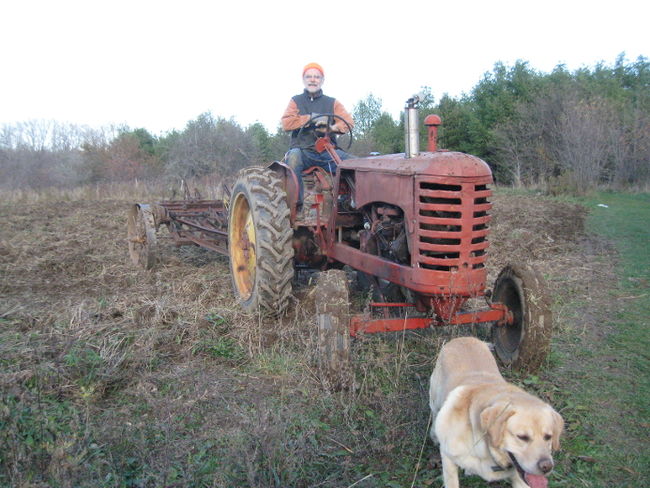
Anyway, sad as that is, sadder still is the fate I’ve apparently left you to in your dotage. There you sit still, outside a tumble-down garage full of way too much stuff of dubious value. Oh, there are some hidden treasures in there no doubt, a few homestead artifacts we were anxious to keep under cover among the other detritus of lives past and present that needs to be sorted out and kept,  or not. But there never seemed to be time as winter approached and other things took precedence. Continue reading

The special bond between man and tractor

As anyone with the most fundamental experience with wood stoves and rural living will know, if you’re just starting to cut your winter’s supply of wood in early to mid-October, you’ve got a big problem.

I imagine that’s just the sort of thing that spelled potential disaster for many a neophyte pioneer family many years ago. Nowadays there are all sorts of options and/or social safety nets for people who’ve foolishly, or for one reason or another, otherwise failed to get their winter fuel supply set aside well ahead of the onset of winter winds. But back in pioneer days, unless the unseasoned pioneer newcomers were fortunate enough to have a few more seasoned newcomers nearby and ready, willing and able to help, the family risked freezing to death.

Dad_Tractor Continue reading

Canada’s plan to bury nuclear waste called “deeply flawed”

One of the world’s leading experts on nuclear safety says the current process leading to the deep-rock burial of Canada’s growing stockpile of highly radioactive, used nuclear fuel is “deeply flawed.”

“There are too many unanswered questions, including about the science, or lack of it, underlying the Nuclear Waste Management’s (NWMO) Adaptive Phased Management Plan to build a Deep Geological Repository for the long-term storage of  millions of used fuel bundles, Dr. Gordon Edwards, co-founder of the Canadian Coalition for Nuclear Responsibility (CCNR) told a crowd of 300 people in the Lake Huron shoreline town of Southampton. Continue reading

Harper Government Hell-bent to Abolish the Long Gun Registry

You would think Nathalie Provost had long ago paid her gun-control dues, by a long shot. You would think she deserved universal respect after being shot four times with the unrestricted semi-automatic rifle Marc Lepine used to murder 14 young women. Six of them died near Provost. She was among the 13 others wounded 22 years and four days ago at Montreal’s L’Ecole Polytechnique in the Montreal Massacre.

Yet an article Provost wrote that was published in the Sault This Week a week ago didn’t just get a lot of comments, most of which disagreed with her gun-control point of view. Some were downright contemptuous, disrespectful, and even scary. Continue reading

Disinterest in Global Warming in Florida

There are many places on earth where the effects of global warming and climate change could be economically, socially, and environmentally catastrophic, depending on the severity of such things as rising sea levels, drought, and the increased frequency of extreme weather events.

Florida is one of those places. Its population of close to 19 million makes it the fourth most populous state in the U.S. It’s the state with the lowest elevation on average, with much of the land in south and central Florida along the highly developed coastal areas and inland barely above sea level. Much about global warming and its effects remains inconclusive and needs more study, hopefully with the support of concerned people and governments around the world. But the basic point, that it is happening, and that to some significant extent will have big impact on the world’s natural environment and human life as we know it, should be indisputable by now. Continue reading