(Author’s note: Among the several province’s in Canada that own and operate nuclear-powered, electricity-generating stations, Ontario has by far the most reactors. They are located on the shores of two of the Great Lakes, on Lake Ontario, east of Toronto, and Lake Huron, near the town of Kincardine. Ontario Power Generation (OPG) is the publicly-owned, provincial Crown Corporation proprietor of Ontario’s nuclear plants. They include the Bruce Nuclear plant near Kincardine, which is operated under a long-term agreement, by a private company, Bruce Power. Highly radioactive nuclear waste, including a growing stockpile of used fuel, is stored on-site at Ontario nuclear plants, as it is elsewhere in Canada. But that is not considered a long-term solution. Canada’s federally-appointed Nuclear Waste Management Organization several years ago proposed an Adaptive Phased Management approach to that issue, including development of a Deep Geological Repository. The NWMO is currently conducting a lengthy site-selection process to find a suitable site. Meanwhile, OPG is awaiting final approval of a separate but similar deep-rock facility at the Bruce Nuclear site for low and intermediate-level, radioactive waste that it first proposed at least 13 years ago. Such waste, is now routinely transported to the Bruce site for what’s also regarded as temporary, above-ground storage. As might be imagined, the idea of burying nuclear waste in close proximity to the shore of one of the Great Lakes, which are shared by Canada and the U.S., has proven controversial.)
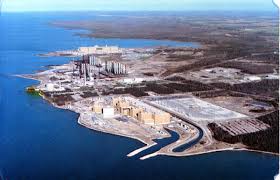
Bruce Nuclear site
I’m not kidding. Well, maybe a little. But I can’t help but wonder if there’s a special room set aside at Ontario Power Generation (OPG) headquarters in Toronto, or its Western Waste Management Facility at the Bruce Nuclear site, where managers go to pound their heads against a wall.
Continue reading →









 Donald Trump
  Finding Hope Ness